Telling Your Child About Their Egg Donation Story
Heads-up: This post contains affiliate links. If you buy something through them, we may earn a small commission at no extra cost to you. As an Amazon Associate, we earn from qualifying purchases.
You don't need the perfect moment or perfect words. Nicole Klein on how to start telling your child where they came from.
Friends, there are all kinds of paths to parenthood, but in Germany, having a child through egg donation isn't legal. Just this week, former German minister Jens Spahn made headlines because he and his husband became parents to a little boy carried by a surrogate abroad (even though his party opposes legalizing surrogacy in Germany).
Nicole Klein doesn't just criticize the law. She's also on a mission to fight the stigma around egg donation, and she helps families who want to tell their children the true story of how they came to be. She even started a publishing house so that affected families can see themselves in books.
Dear Nicole, egg donation isn't allowed in Germany. So many families go abroad, and then face the question: How do I honestly tell my child how they came to be?
For many families, the birth of their baby ends a long fertility journey. With egg donation, it's a journey in the most literal sense, because the legal situation in Germany sends people abroad. But the question of how to tell your child about their beginning often only starts after that, and it can stay with parents for years.
Many parents want to be honest but worry about finding the right way in. From my perspective, it's not about one big, one-time sit-down talk. It's often more natural for kids when their story grows with them from the start, in small, age-appropriate sentences. Then it never becomes a secret or a heavy reveal. It's simply part of the family story.
A survey of affected people by the German Association for Families After Egg Donation found that 88 percent of respondents want support in talking with their child about their beginning. So the need is clearly there…
Yes, and that doesn't surprise me. Many families get medical information before and during treatment. What's often missing afterward is a language for everyday family life. Parents wonder: When do we start? What can a little child understand? How do we keep the story from becoming bigger or heavier than it needs to be for the child? That's why support matters so much. Not because parents can't do it, but because they're often looking for simple words and some direction.
Egg donation isn't allowed in Germany. Can you understand, at least to a degree, the arguments for the ban?

Yes. It's about, among other things, medical procedures on a woman's body, protecting donors, and a child's right to know their genetic origins. Those are real ethical questions.
What I do take issue with is the assumption that a ban solves them. It doesn't stop children conceived through egg donation from growing up in German families. It just moves the treatment abroad, sometimes to countries where donors stay anonymous and where the very transparency that can matter so much to children later on is missing.
So for me, this isn't about promoting egg donation. It's about looking honestly at reality: These children exist. These families exist. The ban doesn't resolve the questions that come with it. It only pushes them to the place where families are often left alone with them later: everyday life with their child.
People affected say they feel the stigma around egg donation, and that it leads to secrecy and to parents staying quiet with their children. Yet experience shows that in families where it's talked about openly from early on, the topic is normal and doesn't take center stage.
When a family story is seen by society as “forbidden” or “complicated,” parents may keep pushing the right moment for an open conversation further and further back. When parents talk about it calmly and lovingly, in a way that fits the child's age, a child can grow up with it as a matter of course. Then the story of how they came to be is part of their biography, but not the center of their identity.
You also give very practical reasons for legalizing egg donation…
Yes. In practical terms, the ban means that many families have to travel abroad, pay high costs, organize most things themselves, and find their way through different legal systems and often a different language too. Legalizing it in Germany could noticeably ease the burden on families, with shorter distances and support within the health care system they know. Family reality is already here. It matters to me that this reality finds its place in law and in society, too.
Families report that they felt well looked after during medical treatment abroad, but often felt left on their own after returning to Germany. What does that support look like?
The support abroad is mostly medical and logistical: treatment plan, medications, appointments, procedures, pregnancy test. Clinics are very professional and well practiced at this. After the birth, back in Germany, the questions are about family communication, explaining things in a way kids can understand, and how your own story can find a natural place in everyday life.
This is where networks like FE-Netz e.V. do very important work. They create visibility and show families they're not alone with these questions. Counseling can also offer helpful direction. But for me, social normality shouldn't depend only on volunteer efforts or a handful of counseling services. It should also show in the way families like these are simply taken into account in everyday life.
Last year you founded the independent children's book publisher Glanzfunke, aimed at families after fertility treatment, egg donation, embryo donation, or sperm donation. How did you come up with the idea, and what feedback have you gotten from readers?
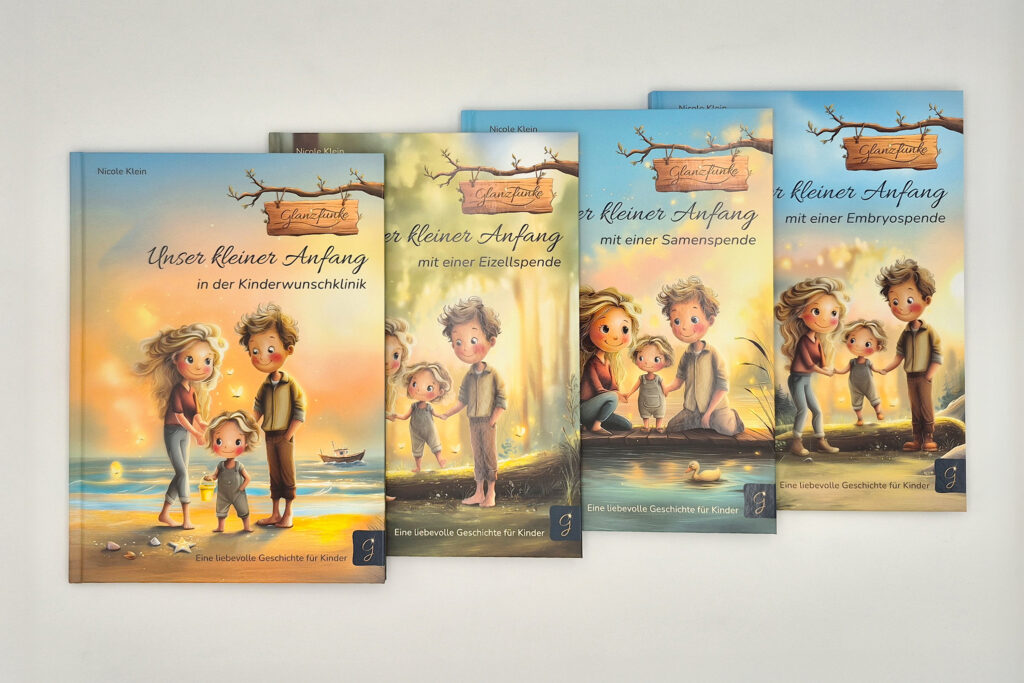
Glanzfunke grew out of a simple question: What actually happens after fertility treatment? Because at some point it's no longer about medical procedures but about family life: How do I tell my child how they came to be, so that they can grow up with the story as a matter of course? We noticed a real gap there: there's very little support for kids for the time after treatment.
We wanted to create books that don't explain like a medical guide but tell a story like a children's book: lovingly, calmly, honestly, and without heaviness. The book “Unser kleiner Anfang mit einer Eizellspende” (“Our Little Beginning with an Egg Donation”) is about a wish that was stronger than every hurdle, about loving hands that helped, and about the moment a dream finally came true. Kids should be able to hear their story in language they understand. And parents should feel: I can just start. I don't have to explain every detail perfectly.
The feedback is often very emotional: Parents write to tell us they teared up the first time they read it because they found themselves and their story in it. Midwives tell us they see in the books exactly the way in that many families have been missing. And we hear from fertility centers that the books are a valuable bridge between treatment and family life. That means a lot to us, because it shows that this isn't only about a children's book. It's about a loving way to start the conversation.
What would you like to leave affected families with, in closing?
I'd like to tell families: You don't have to explain everything at once. And you don't have to do it perfectly. A beginning with the help of a donor, or fertility treatment, doesn't make a family any less real. Above all, kids need to feel that their story has a loving, safe place in the family. My wish is that one day all children can say: “I know my little beginning, and it belongs to me.”
This story first appeared in German on StadtLandMama.