A Stroke at 40: A Mom of Four on Finding Her "Why"
A strange gurgling in her ear on a family vacation, and a certainty she still can't explain: Johanna knew she was having a stroke.
Dear friends, Johanna is a mom of four who had already survived meningitis when everything changed in the middle of a family vacation: she had a stroke at 40. She remembers the ride to the hospital only in pieces, but her family has filled in a lot. Today she doesn't want to waste any more time, and she has found a new purpose, a new "why" for her life… truly impressive!
Dear Johanna, you were on vacation with your family when suddenly something felt off. How did it all start?
We were on vacation in Turkey, and it was a totally normal family day with four kids, with noise and movement and that typical chaos you barely notice anymore as a mom because it's just become part of life. At some point my body started to feel strange. At first it was very subtle. I suddenly couldn't make out patterns clearly, things seemed off-kilter, as if my brain had stopped sorting information properly, and in my right ear there was a weird gurgling, a feeling of pressure I couldn't place.
It wasn't strong pain. It was more like an unsettling, quiet signal I couldn't ignore. I took our youngest daughter to bed, it must have been early evening, and while I was lying next to her, I already knew something was wrong. When I went downstairs to my husband and my older kids, I said, something is off here, I think I'm having a stroke, even though I had no medical knowledge of the typical symptoms. Still, that word was suddenly there, clear and certain, and to this day I don't know how I knew.
A stroke at 40. How far back does your memory go?
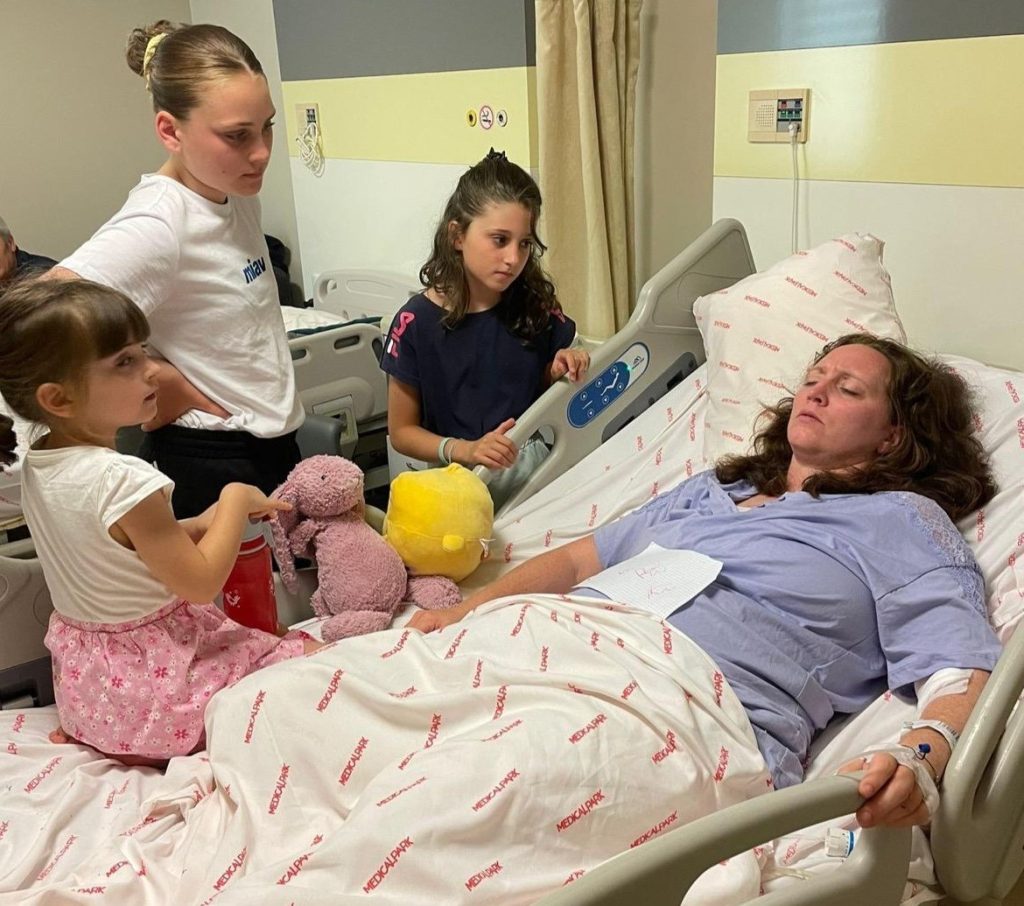
My memory is full of holes. There are a few islands, but big gaps in between. I remember saying that something was wrong, I remember that inner knowing, but what happened after that gets blurry. My husband told me later that in the car on the way to the ER, I was still talking to him fairly clearly. But I have no memory of that at all. In the ER I then had epileptic seizures. I don't remember any of it.
What did your husband and kids tell you later about those first hours and the shock?
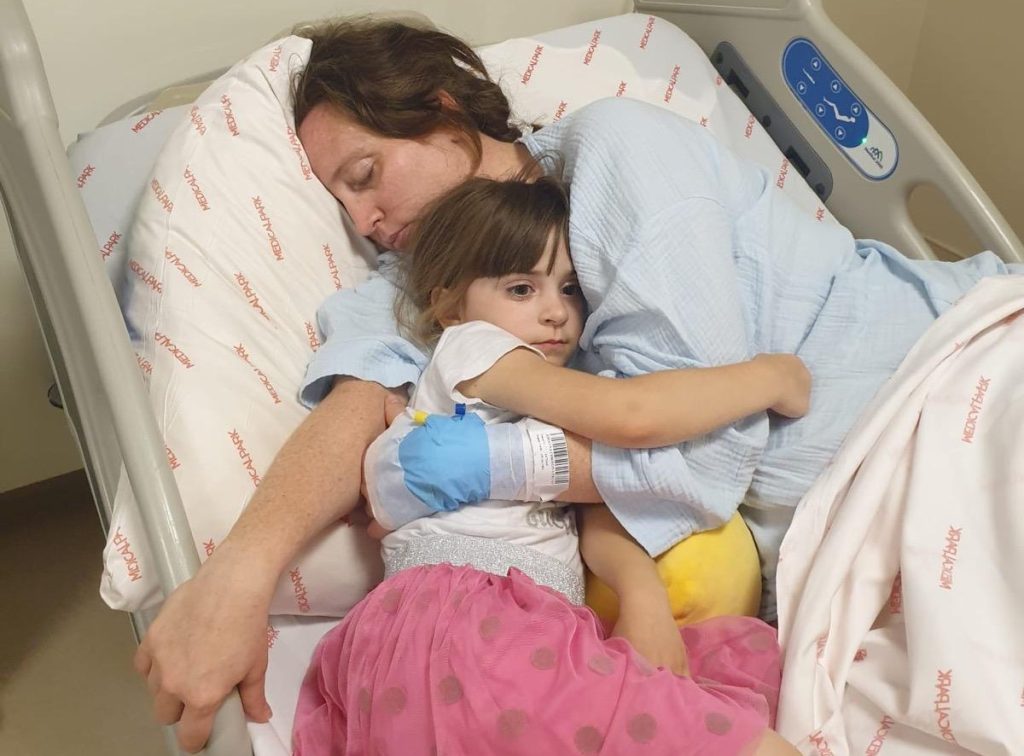
My husband told me how quickly a normal evening turned into an emergency, how a family vacation suddenly turned into a hospital stay and a life-or-death situation. What hit me hardest was the goodbye. When we walked to the car, the kids came along, and apparently I hugged them and said, maybe this is the last time we'll see each other.
I don't remember it myself. I have no picture of it, only what they told me. For a long time I chewed on that sentence, because I've always thought of myself as very careful with my words, especially with my kids, and looking back, it felt thoughtless to confront them with something so final. My neuropsychologist helped me make sense of it later. She explained that my brain was already in a complete state of emergency and couldn't regulate emotions anymore. It wasn't a calculated sentence, it was an existential one. Still, it stays between us, and I can't sugarcoat it.
You've also had a near-death experience…
Yes, but not in connection with the stroke. It was back in 2019, when what started as a basic cold and a sinus infection turned into life-threatening meningitis and encephalitis, caused by pneumococcal bacteria. At that point I was pregnant with our third daughter. Statistically, I'm in a tiny percentage of people, because cases like mine are rare.
My brain was inflamed, and within a short time I was in a coma. My near-death experience wasn't anything spectacular, no tunnel, no looking down from above, just a state of complete peace. I met relatives who had died. It felt natural and peaceful, without fear and without a fight. It wasn't a conversation in the earthly sense, nobody spoke in words, and yet the message was unmistakable: You can't stay here, you still have something to do. For me that was very concrete, because I was pregnant, carrying a baby who was meant to be born.
I didn't take it as a spiritual calling but as something very down-to-earth: there was still a life that wanted to come into the world through me, and for that I had to go back. I pushed this experience away for a long time. I wanted to get back to normal and back to functioning, but my basic trust in life had been shaken and I developed a deep fear of death.
How long were you in the coma, and did you pick up anything from the outside world?
I was in a coma for several days and I didn't pick up anything from the outside, no voices, no touch, no conversations. My only memory from that time is that state of peace. My conscious memory doesn't start again until I woke up. I was lying in a room I'd never seen, and I didn't know where I was or why I was there.
Above all, it was the stimulation that overwhelmed me: the light, the sounds of the machines, the smells. Everything was glaring, loud, and strange. I couldn't sit up, I had nothing to hold on to, and then came this unbelievable fear. My heart was racing and I was convinced I was dying. I kept saying, I'm dying now, until a nurse came, held my hand, and breathed calmly with me, telling me that I wasn't dying, I was having a panic attack.
The shift from that complete calm to being physically overwhelmed was brutal, and if I'm honest, in that moment I preferred the peaceful state of the coma to being in my body. Not because I didn't want to live, but because I was so completely overwhelmed.
When does your memory first kick in again?
There's no clear moment. My memory comes back in fragments: a strong feeling of thirst, panic, a pounding heart, the nurse's hand, his calm voice, and then a digital clock on the wall that showed December 28, 2019. I had fallen into the coma on December 23, 2019. That date was like an anchor, because it made me realize that several days were missing.
When I see photos from right after I woke up, I can't remember them. Clearer scenes only come later: medical exams, the spinal tap, and finally, when I was allowed to leave the ICU for a regular hospital room, my kids coming to visit. One of my first clear thoughts was wondering how the baby was, whether the baby was okay. I do remember that.
What was it like when you first felt your body again?
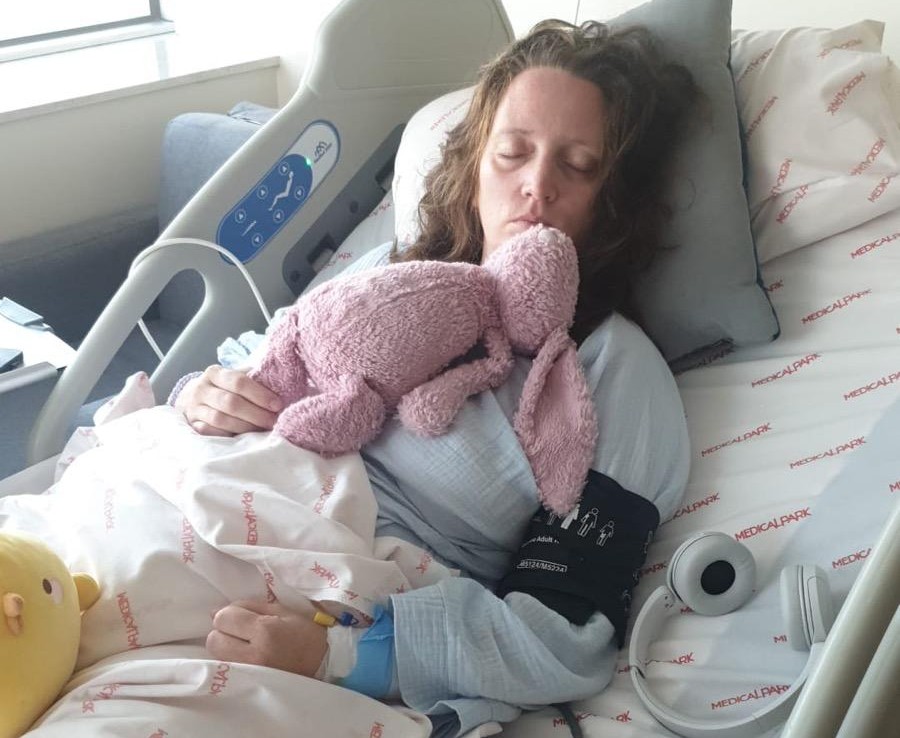
Mostly I remember panic. My heart was racing and I was convinced I was dying. The contrast was enormous: in the coma I'd experienced complete calm, and now I was back in a body full of stimulation, full of noise, full of pounding heartbeats. It was overwhelming and frightening. I actually preferred that calm state, not because I didn't want to live, but because the physical side was so massively overwhelming.
When did it sink in that everything was different now?
After the meningitis and encephalitis in 2019, not right away, because I was pregnant, had two older kids at home, and was busy getting back to functioning. But my basic trust in life had been shaken. A basic cold had turned into a life-threatening situation, and I developed a deep fear of death. It wasn't until after the stroke in 2024 that I couldn't push it away anymore, because standing at that threshold a second time wasn't something I could just organize away.
Fairly quickly the thought came: This didn't happen for nothing, it must mean something. In the years before, I had done several therapeutic trainings, including one in logotherapy. Viktor Frankl said, "Those who have a why to live can bear almost any how." It became clear to me pretty fast that I didn't want to fall back into that panic, and very soon after my stroke I started regulating my nervous system, through self-hypnosis and brain wave training, among other things.
In what ways are you still affected today?
My visible physical limitations have mostly gone away. If you saw me today, you probably wouldn't say, "That woman had a stroke," but I live with what's called an "invisible disability."
My nervous system has become much more sensitive. My capacity is limited. Stimulation, stress, conflict, or too many appointments back to back can overwhelm my system quickly. And that has immediate consequences. If I don't slow down, if I don't set clear priorities, if I don't take my limits seriously or don't communicate them, I crash.
That's not theoretical knowledge, it's something you feel in your body. You can't separate the existential from the physical. My nervous system forces me to live differently. With more awareness, more clarity, and less overloading myself. I used to be able to compensate for a lot, and now that doesn't work anymore. Even though it's a limitation, it's also a radical education. My body is no longer something I can override. It has become my measuring stick.
What has all this done to your family?
It has shown us as a family how fragile life is. Not in a dramatic way, not constantly front of mind, but as a quiet knowing in the background that's always there: Nothing is guaranteed. We've learned to pay closer attention to each other, not just logistically but emotionally, and in the hustle of everyday life to simply ask now and then: Are you really okay? Are you overwhelmed? Do you need a break? When one of us keeps pushing past our limits for too long, it affects all of us.
And we've started talking about the things people usually like to leave out: dying, death, goodbyes. Not in a dark, fearful way, but honestly. We can't cross these topics out of life, because they're part of it. Sooner or later each of us will face them. So why pretend they don't exist? I talk very openly with my kids about it, and with my husband too. These topics don't scare us anymore.
It matters to me that when the time comes, my kids can develop a healthy way of dealing with dying, death, loss, and grief. I want them to know that dying is part of life and that grief is allowed to be there without destroying their own lives. I hope they learn to take goodbyes in without being broken by them. Maybe that's part of what we've taken away from these experiences as a family: a greater awareness of each other and less fear of what can't be said out loud.
Did you have that strong will to live the whole time?
No. After the meningitis in 2019, I definitely didn't. I was deeply afraid of dying. I had lost my basic trust in life. A basic cold had turned into a life-threatening situation. My brain had been inflamed. That experience shook me to my core. I didn't have any feeling of "Everything happens for a reason." I was scared. And I just wanted everything to go back to normal.
After the stroke in 2024, it was different. I remember that fairly soon after I was fully conscious again, a thought came up: This didn't happen for nothing. It must mean something.
In the years before, I'd gotten additional training in therapy, including logotherapy. Viktor Frankl, the founder of this meaning-centered form of therapy, said: "Those who have a why to live can bear almost any how." That sentence suddenly became very real to me. I knew: I didn't want to fall back into that paralyzing fear of death like in 2019. I wanted to find a different way through.
I started very early to actively regulate my nervous system, through self-hypnosis, among other things. I deliberately put myself into states of relaxation and worked with my brain waves so I wouldn't spiral into panic. That helped me a lot. At first I was in a clinic in Turkey. My mother came from Germany and stayed with me in my room. We laughed an incredible amount.
We even apologized to the doctors, because we thought maybe it was inappropriate to laugh so much in a situation like that. But they said: There's nothing better for healing. I believe that laughter wasn't denial, it was acceptance. Fairly early on I found an attitude: It is what it is. And I'll look for my way through it. That doesn't mean everything was easy. But I was no longer in that existential fear like in 2019. It was more like a wide-awake yes to life.
Why are you training to become a hospice volunteer?
In this life I've had experiences that not many people have in this way. Twice I got to stand at a threshold, a place where mortality is no longer theoretical but real. I know what it feels like when everything suddenly stops, when your own life or the life of someone you love can no longer be taken for granted.
And in the hospital I experienced something that moved me deeply. Even though I was a patient myself, I ended up having conversations with the women in my room, women who were seriously ill or even dying. We talked. Sometimes we just sat together in silence. I could listen, hold a hand, be there. For family members too. That's where I realized: This space doesn't overwhelm me. It doesn't scare me off. On the contrary, I feel very clear there.
I don't believe people "need me." But I do believe that in places like these I have something to offer, out of experience and out of humanity: a presence, a willingness to stay with it, to walk alongside. Many people get thrown into situations like this completely unprepared, with no experience, no language, no rituals.
At the same time, as a society we keep pushing aging, dying, and death further to the margins, because they aren't productive, aren't profitable, and aren't high-performing. We lose touch with them, and I believe we uproot ourselves in the process. We shut it out of our everyday lives until suddenly it affects us ourselves and we don't know how to handle it. I think we need more points of contact, more rituals, and more spaces where these topics have a place.
For me, hospice work isn't a dark place. It's a deeply human space. A space where dignity, goodbyes, gratitude, and even humor are allowed to exist side by side. I want to help us learn again not to outsource these thresholds, but to accompany them consciously.
What would you like to tell everyone who thought they had unlimited time?
Believing we have unlimited time is an illusion. And it's just as much an illusion to believe that enough discipline, enough optimizing, enough control can protect us from mortality. We can perfect our diets, structure our routines, plan out our calendars, but none of it makes us immortal.
When we were born, we made a deal that we'd leave this world someday. That's not a threat, it's a fact. And I think we do ourselves no favors by blocking out that fact and shutting it out of our lives and our society.
When I ask myself today what will remain when I'm no longer here, I don't think first of possessions or achievements. Of course things will remain. Maybe a house, maybe money, maybe written words, but what matters most is something else: the feeling people associate with me. Whether they felt safe around me. Whether they felt seen. Whether they remember shared moments when they got to laugh or be honest.
When I keep that in front of me, my priorities really do shift, but not in a dramatic way. It's not a radical break, it's a quiet correction. Then it becomes more important to have that conversation today that I keep putting off. Then it becomes more important to listen to someone instead of glancing at my phone on the side. Then it becomes more important not just to manage my kids, but to really meet them.
It doesn't mean I stop making plans or stop taking on responsibility. But it means I'm aware of what I'm trading my time for and who I want to share it with. Because time is the one thing we can't make more of. And maybe that very awareness isn't a reason for fear, but an invitation to live more wide awake.
This story first appeared in German on StadtLandMama.