Why Giving Birth Is Political, According to a Doula
Heads-up: This post contains affiliate links. If you buy something through them, we may earn a small commission at no extra cost to you. As an Amazon Associate, we earn from qualifying purchases.
She was told to stop screaming in labor. Now doula Nadine Birner explains why none of that was just her bad luck.
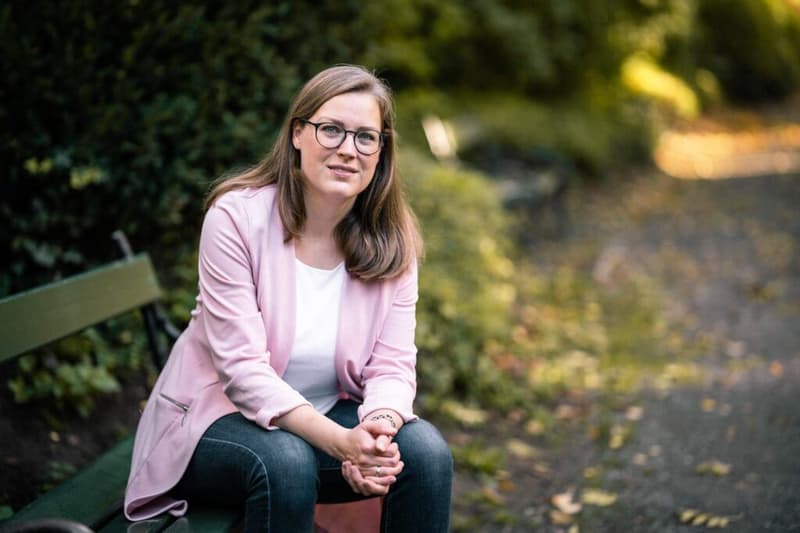
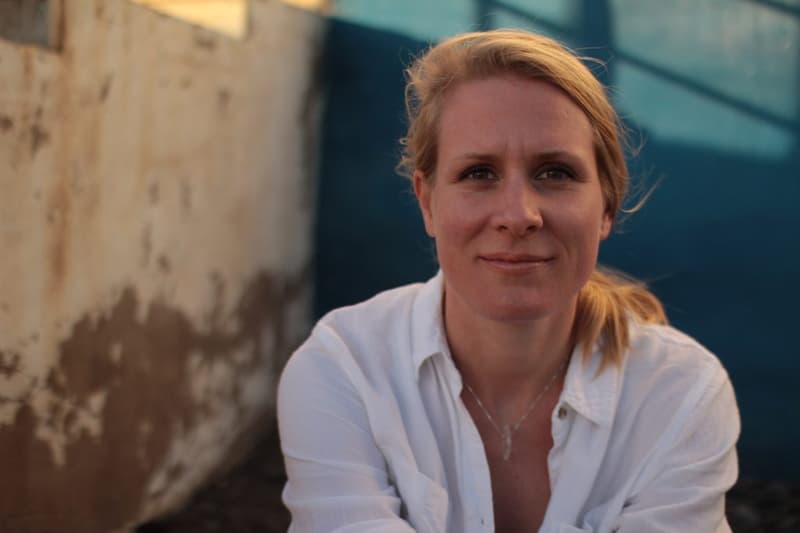
Friends, Nadine Birner is a doula, and she says: “Birth is political.” She's convinced of this: “Pregnant people want to be taken seriously, not brushed off. They need real knowledge, not half-truths. They need community, not a solo act.”
And above all: “They need to see the big picture, the context and the structures.” She's offering all of that now because she believes in it. And because she's convinced it matters a great deal, both for each of us individually and for all of us collectively. Her words are worth hearing even if you're no longer pregnant, because this topic follows us through all of motherhood.
Nadine, you say birth is political. And pregnancy, too. What do you mean?
We aren't pregnant in a vacuum. We're pregnant in the middle of a society where certain images, ideas, and narratives dominate: how a pregnancy and birth are supposed to go, how a pregnant or birthing person is supposed to behave. There are rules and norms, some spoken, most of them unspoken, but very powerful.
So when I say pregnancy and birth are political, I mean they're embedded in structures, and therefore in power dynamics. In a health care system that controls and standardizes a lot and asks and individualizes very little. In a society that demands we adapt and often celebrates self-determination only as a trendy buzzword. What that means in concrete terms, and we've known it for several decades now: the personal is political, and politics runs through everyone's daily life.
It's in our passports, in our wallets, in our pregnancies, and in our births. The social and political context decides whose pain is taken seriously, whose worries get heard, which behavior from a pregnant person is considered acceptable, what kind of access she has to which medical care, and so on. For my clients, recognizing and understanding this is usually a turning point, the moment they realize: it's not me, the problems are structural.
Do you think democracy starts in the kids' room?
If the idea behind that question is that we listen to our kids, take them seriously, include them in decisions in age-appropriate ways, and let them help shape family life, then yes. If it means there's room for negotiation, for different needs, for experiencing both autonomy and limits, then also yes.
The way I see it, family is the safe space where kids explore community and practice living together. A place to experiment, to try out their own ability to make things happen and to shape their world. I'm well aware that I'm not alone in this view, but that in many cases it's still far from reality.
At the beginning of their lives, our kids depend on us completely, and it makes a huge difference whether we make them feel that dependence or meet them at eye level, in a way that fits their age: through how we talk to them, through our body language, through how we include them and let them take part.
If we accompany their childhood with security, respect, affection, and the trust that they're allowed to help shape things, they grow into a sense of belonging and responsibility. Then they can become adults who see themselves as part of our democratic society and get involved in it.
You work for a dignified start to life. How can that happen?
A dignified start to life happens on two interlocking levels. On the personal level, it takes knowledge, self-determination, and the freedom to choose. And on the structural level, it takes a society that actually allows for that.
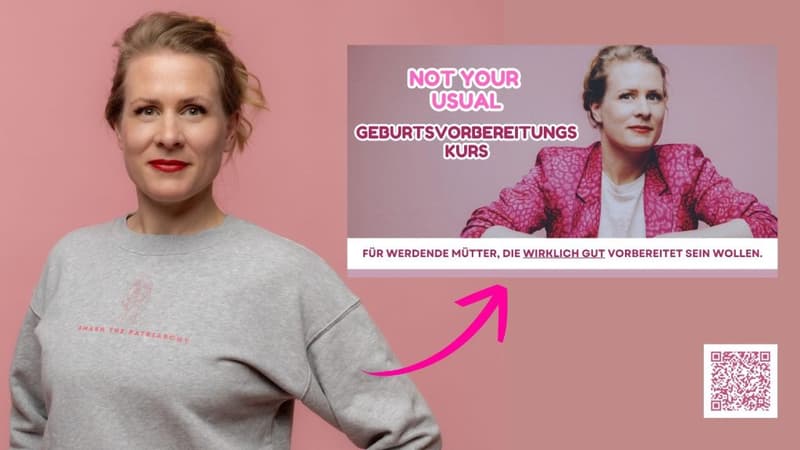
On the individual level, we can often get started faster, and that's exactly what I do with my childbirth class, which starts in September. We question clichés, recharge our sense of self-determination, and create a space for exchange that holds us up.
On the structural level, it often feels like a long, slow slog, but we have to walk it anyway if we want lasting change. Because what good are your birth preferences if you're tilting at windmills in the delivery room? What good is your self-determination if you're exhausted from constantly swimming upstream? What good is everything you know about gender roles and the mental load if society keeps celebrating the “power woman,” the “everyday hero,” the “supermom”?
For me and my work, that means it's not only about strengthening people personally during the pregnancies I support. It's also about making visible the conditions under which decisions can be made in the first place. One doesn't work without the other.
Why did you train to become a doula?
My pregnancy turned my professional life upside down, too. I had hyperemesis gravidarum, and from one day to the next I was out of my job. I was on medical leave and couldn't finish my temporary project contract. And then the boundary-crossing started, which left me speechless and then furious: I spent several days in the hospital, twice, because I was in terrible shape. At one hospital, a doctor discharged me for “lack of compliance” because I asked critical questions about my treatment plan.
My OB-GYN did an ultrasound even though I had explicitly said no beforehand. When I went to the labor and delivery ward to register, the midwife asked whether I wanted to give birth “like a hundred years ago.” And when I showed up to actually give birth, the first thing I heard from the doctor was: Now stop screaming like that!
I thought I'd wandered into the wrong movie, and at the same time I realized: all of this counts as “normal.” I was constantly given the message that I was the one who had it wrong. That I should go along, not make such a fuss, be cooperative. I'd already lived over thirty years as a woman in our society and knew about being judged, controlled, and mindfucked, but as a pregnant woman that grip got enormously stronger, and violent overstepping was treated as normal. From then on it was clear: the way this works, it can't go on like this!
Pregnant people want to be taken seriously, not brushed off. They need knowledge, not half-truths. They need community, not a solo act. And above all: they need to see the big picture, the context and the structures. I'm offering all of that now because I believe, to put a spin on a much-quoted line, that it matters how we are pregnant and how we give birth. Quite the opposite of not mattering: it's very significant, both for us individually and for all of us collectively.
What are the biggest hurdles for brand-new moms today, and how have the issues in the postpartum weeks changed?
I've only been working as a doula for a year, so I can't speak with any authority about how the issues have changed over the years, but I can say something about the ones that dominate today. The postpartum period is an extremely sensitive, vulnerable time. For the person who gave birth, a lot of different things are happening at once: recovering from the birth and feeling their way into a new daily routine with a baby.
What many people don't expect is how the feeling of having no control over your own life kicks in once the initial euphoria wears off. I remember exactly how, after my own child was born, I realized: I can't just go to sleep when I'm tired anymore. There's someone who needs me, and I have to organize myself completely differently if I want time and quiet for myself.
And that's often not a gentle arrival, but sometimes more like a crash landing. On top of that come all the expectations and romantic ideas we decorated our postpartum weeks with, which often collide with reality. If there's a partner in the picture, things can get creaky, because a lot looks different in practice than it did in theory. And the people around us aren't always as supportive as we hoped or as they promised.
Then there's this vague pressure from every direction: get back in shape fast, bounce back, the whole “after-baby body” thing, go back to work as soon as possible, or else stay in bed as long as possible. I think it helps to keep asking yourself: What's good for me? What can stay on the back burner right now? Whose feedback is useful to me at the moment, and which can I happily ignore? The postpartum period is a huge transition that needs space, quiet, and support, not even more demands and everybody's wish list.
You call yourself a feminist. As a doula, do you also work with the dads and try to bring a good balance?
My focus is first and foremost on the pregnant person: her well-being, her needs, her questions and wishes. In the vast majority of cases that's already more than enough to do. At the same time, it makes sense to widen the lens and include partners in the process. In my work that usually develops on its own when we get to topics like birth, care work, or the mental load. Then partners step into the picture, and together we dig into questions that matter to both sides.
Because as much as I concentrate on the pregnant person, I also know that individual change can accomplish very little if the system around us doesn't budge. Then the wiggle room stays small. For change to last, things have to move on several levels and across the whole system.
Still, my main focus stays on the pregnant person. That's important to me to say. Because even today, pregnant people, even in their closest circles, often get only one-dimensional attention: as the carrier of the unborn child. With me, it's different. I want to see and support the whole person, with everything that's there: history, doubts, wishes, anger, questions, strength. And yes, I think expectant fathers and other important people in the family also need stronger, more targeted support. There's a lot of potential there, too, just waiting to be tapped!
What would your ideal of fairly shared parenthood look like?
I find the idea of a parenting team, which I borrowed from Hanna Drechsler, very fitting. A team where everyone treats each other with appreciation, real interest in one another, and a willingness to share responsibility. A team where everyone's needs and wishes count, and where things are renegotiated again and again: Who takes on how much care work? Who takes on how much paid work? Who does the housework? Who gets room for hobbies, volunteering, and free time, and when?
I also believe, by the way, that equal parenthood doesn't stand in the way of romantic love and a romantic partnership. Quite the opposite: only through equality can a love of mutual respect, between equals, really grow.
What do you manage well in your own daily life that you pass on to your clients, and what not so well?
Ah, the beloved topic of self-care. Especially in pregnancy and the postpartum weeks, it's a fundamental act of self-preservation. My clients are creating new life, which is incredibly draining on every level: physically, mentally, emotionally. And with the birth comes a whole new level of availability and commitment. But you can't pour from an empty cup, and in the vast majority of cases, pregnant people and people who have given birth don't get anywhere near the care they need.
With my clients, I work on an understanding of self-care that's more than a spa visit with a pregnancy-glow face mask. It's not about wellness or beauty ideals, but about the deeper questions: What do you need to feel safe? Held, strengthened, connected with yourself? What nourishes you, what brings you back in touch with yourself? Sure, the face mask can be part of a self-care routine, but I think it's just as important to recognize that self-care can also be uncomfortable. It also means questioning how you talk to yourself, which patterns you keep repeating, which conflicts you avoid, and which responsibilities you do (or don't) want to take on.
At the same time, self-care also means being kind and gentle with myself. Not beating myself into functioning, but taking up space that society doesn't automatically grant me, and finding a balance between my daily life and my needs.
I manage that sometimes better, sometimes worse. I know pretty precisely what's good for me and what I need, but saying no to the desk and yes to the couch is often hard for me. Same with not starting an evening shift at the laptop after getting my child to sleep, and driving out to the lake instead. Right now especially, while I'm building my business, I find it really challenging to strike a good balance. But I also notice: where there's no strength, there's no impact. And I take that very seriously. And then I happily reach for Svenja Gräfen's book “Radikale Selbstfürsorge Jetzt!” (Radical Self-Care Now!)
What do you wish for moms at the start of the adventure of having a child?
Above all, I wish them caring, kind companions on their way. Trusted people, whether friends, a midwife, or a doula, who are there for them, who hold them up and catch them, who listen to understand, not to respond. Who are simply there and offer their care with no agenda. Who step back without leaving you alone. Because in my opinion, nothing is worse than going through this challenging, everything-upside-down time alone, and I want to stress here that you can feel very alone even in company.
This story first appeared in German on StadtLandMama.