
After Postpartum Depression, She Dared to Have Another Baby
Everyone asked if she was crazy to want another baby. After the darkest year of her life, Ulrike chose to try again. Here's what happened.
Ulrike Schrimpf dared to try again. After postpartum depression hit her following the birth of her second child, she has now had another baby, and she hasn't gotten sick again. A happy ending? Yes. But one she had to fight for.
By Lisa Harmann
Are you crazy? Why would you want another baby? Baby Felix gurgles and grabs a fistful of his mom's hair. The fact that he exists isn't crazy, but it does take courage. His mom, Ulrike Schrimpf, 40, developed postpartum depression after the birth of Felix's big brother Michael, now 5. It hit her so hard that at times she wasn't sure she wanted to go on living. And still she took the chance again: she had a third child, Felix. He's seven months old now.
Writing pulled Ulrike out of the valley
Pictures of Zara, the heroine of Ulrike's children's books, hang in her apartment. Zara, a fictional character, helped pull Ulrike out of the crisis she calls “one of the worst states a mother can ever experience.” While she was in the psychiatric hospital, her first son, Johannes, now 10, asked her to write him a story. As she wrote it, Ulrike felt something like joy for the first time in a long while. A distraction. A kind of self-healing. She's worked as an author ever since. Besides the three Zara novels for kids, she has written a powerful book about her illness: “Wie kann ich dich halten, wenn ich selbst zerbreche?*” (roughly, “How Can I Hold You When I'm Falling Apart?”).
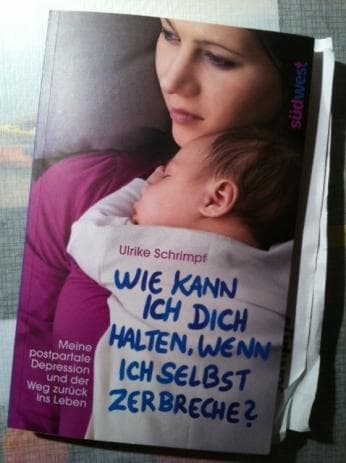
The ghosts mostly came at night. “My nights are glaring white, haunted by ghosts of obsession,” Ulrike writes in her book. “I'm shaking, my teeth are chattering. My hair and my face are soaked with sweat. The fear rattles me. I feel sick. My son wakes up and nurses, determined and brave. He moves me so deeply! My tears drip onto his face, his little arms, his soft baby fuzz. Suddenly I know: Nothing is okay. I need help!”
It was November when Ulrike had her second child. Outside it was cold, dark, frosty. Inside her, too. Unlike some other mothers, Ulrike didn't develop a bonding problem with her baby during her illness. A common misconception is that mothers with postpartum depression can't love their children. In fact, that's true for only 30 percent of the mothers who get sick. With Ulrike, it was almost the opposite. She loved her child so much that she developed irrational worries.
Panic attacks and fear: when depression reaches for you
Ulrike was afraid. Afraid she wasn't a good mother to her kids. Afraid of ruining her relationship. Afraid she'd never again do anything challenging or interesting with her life. She was afraid of sleeping and afraid of living. She no longer trusted herself to carry the baby down the stairs, so she scooted down one step at a time, sitting. “You, depressed? Don't make me laugh,” her twin sister said on the phone. Nobody would have expected it. Least of all Ulrike herself.
“But you wanted this baby,” people said. Exactly. And she still wasn't okay. The illness came over her like a force of nature. Her second child was ten weeks old when Ulrike checked herself into the hospital. She had trouble sleeping, a racing heart, panic attacks, drenching sweats. And she had guilt. What kind of mother am I?
She spent three weeks in the clinic. “When you're depressed, you feel the negative things more intensely, and you stop noticing the positive ones altogether,” Ulrike says. But the treatment helped, and she was soon discharged. After four months came a relapse. Intense, but short. What she didn't know yet: recovering from depression isn't a straight line. It's more like the way a dolphin moves through water, in arcs that curve upward. After that relapse, things finally kept getting better.
Who gets postpartum depression?
Giving birth is one of those threshold experiences in a person's life, where saying goodbye and starting over are tangled together. About 19 percent of all mothers develop depressive symptoms after giving birth, and seven percent of them have a severe depression that needs treatment. Most women get sick six to eight weeks after the birth.
“Sixty percent of the women who come to me are college-educated women between 30 and 40,” says Dr. Claudia Reiner-Lawugger. For 15 years, she has headed the outpatient clinic for perinatal psychiatry in Vienna. Women like Ulrike. After years of living successful, self-directed lives, they suddenly find themselves in an apartment with a baby, far from their offices and friends. Nothing is as orderly and reliable as they're used to. “For me, the most exhausting part was feeling responsible for everything, every bad mood and every conflict,” Ulrike says. But no single factor causes depression. With Ulrike, several things piled up. A failed relationship, the one with the father of her first son. A move from Berlin to Vienna. A miscarriage. Her father's illness.

The odds of recovery from postpartum depression are good when women get help. In most cases, a huge improvement comes just three to four weeks after treatment begins, the doctor says. That's how it went for Ulrike. She had psychotherapy and was prescribed antidepressants.
Ulrike had always wanted three kids. With every day that passed after the illness, the wish for another child crept closer. “Illness is like childbirth. The longer it's behind you, the more you push the pain away.” Her husband wasn't exactly sold on the idea of a third child. “Everything is so nice right now just the way it is,” he said.
Should she skip having more children because of the depression?
Should she give up on more children out of fear that she might fall into another crisis? Ulrike sensed that she would always regret not having a third child. “I wanted another baby. But I never wanted to get depression again,” Ulrike says. Her doctor told her: “Then don't stop the antidepressants in the first place.” Ulrike kept taking medication, at a low dose, but she kept taking it. Don't stop? Not even during pregnancy? Dr. Reiner-Lawugger says: “There are antidepressants that can be taken during pregnancy and while breastfeeding.”
Ulrike followed her advice, and she still takes antidepressants today, at a low dose. “Nobody tells someone with a heart condition to just go get some fresh air.” She still remembers how the medication helped her back then, and how the old Ulrike slowly came back.
“I was tired of living. I didn't want to go on like that. It was a traumatic experience I'll never forget. I didn't have any thoughts about how I would actually end my life. But there was this passive feeling of, wouldn't it be convenient if a car came along right now, then the pain would be over.”
When Ulrike talks about it now, she can no longer relate to it. “Because I love my life so much now.” She remembers what her doctor said to her husband during her illness: “You can't understand this illness.”
Ulrike got pregnant with her third child four years after the illness. In her fourth month, she had a panic attack. “I lay there awake and thought: How could I forget how awful this feels? I can't do this again.” As much as she wanted a child, she wondered why she'd had to tempt fate a second time.
Oh no, is the depression coming back?
That state lasted two weeks, and then the worries faded. Things stayed calm until the birth. Then came Felix. His name means “the happy one.” The first night after delivery, Ulrike didn't sleep well. For a moment, she was afraid of spiraling back into that dark cycle. But at the same time, Ulrike dared to trust that everything would be okay. And it was.
During his first four months, she often found herself marveling: Huh, I'm actually doing fine. Since then, she's trusted that it won't happen again. And it didn't. After Felix was born, Ulrike stayed well.
Felix laughs through the baby monitor. Ulrike gets him up from his morning nap, and he's wearing tights with little stars on them. We eat croissants and Topfengolatschen (flaky pastries filled with quark, a soft fresh cheese). Ulrike gets up for a moment to scrape a green slime hand off the wallpaper. She laughs. “My boys!” Then we head out to Claudia Reiner-Lawugger's clinic. Ulrike still visits her now and then.
The psychiatric hospital: a place of fear, and of rescue
On a day like today, the trees in the park in front of the hospital make it look like a castle garden. Back then, they scared Ulrike. Their shadows weighed on her the first time she walked up the hill toward the outpatient clinic. It was winter, and the trees looked frightening, like skeletons whose branches might reach out and grab her. Now I'm officially crazy, Ulrike thought. Today, in the sunshine, the leaves and branches cast pleasantly cool shade as we walk uphill. Nothing hints at the dark valley Ulrike walked through.
We sit down in the waiting room. Colorful close-up photos of candy hang on the walls. The balconies of the building are fenced in with bars, a precaution. A woman wearing a headscarf, with a baby about eight months old, speaks to Ulrike: Aren't you the woman who wrote that book? And now you've had another baby? Do you think I can do it too?
Many women who've been through this ask themselves the same thing. Ulrike encourages the mother, the way a good therapist would: “It won't happen to you like THIS again.” Because it really won't be exactly the same. Maybe similar, but not like this. Anyone who has been sick once has already built a network of doctors and people who support them. That creates a sense of safety.
Everyone's supposed to be happy when a baby arrives...?!
We're allowed into the treatment room. Just above the doctor, birth announcements hang on the wall, cheerful greetings welcoming babies to the world. Everyone is supposed to be so happy when a baby comes. Claudia Reiner-Lawugger sits across from us. Ulrike kisses Felix's forehead. “Of course it's not always easy with a third child, but it's good. I would choose Felix again in a heartbeat.” “Look,” she says to the doctor, “Felix is looking at you like he knows he wouldn't be here without you.”
WHERE WOMEN WHO ARE AFFECTED CAN TURN:
Marcé-Gesellschaft für Peripartale Psychische Erkrankungen (a German-language society for perinatal mental illness): Marcé Gesellschaft
Schatten & Licht e.V.: Initiative for perinatal mental illness: Verein Schatten und Licht
FURTHER READING:
"Wie kann ich dich halten, wenn ich selbst zerbreche?": A very personal book review
_________________________________
*Amazon affiliate link
Photo of Ulrike Schrimpf: Natascha Unkart
Photo of baby cradle: Pixabay
This story first appeared in German on StadtLandMama.