My Kid Is a Daydreamer: How We Get Through School Without the Stress
Your daydreamer is happily drawing a beetle while you eye the clock. Two psychologists on how to stop the nagging spiral without giving up on school.
Hi, friends with school-age kids: you know that things don't always run smoothly. When one of our kids is a dreamy one, the pressure and the to-dos can get exhausting. For everyone involved! Today, psychologists Fabian Grolimund and Stefanie Rietzler are here with a guest post full of good ideas on how learning, focus, and staying power can still work out.
"Take a moment and think of some happy moments from your childhood. What pictures come up? Where are you and what are you doing? Are you alone, surrounded by siblings or friends, with your parents?
Maybe, like us, you think of warm summer evenings when you were allowed to stay out late playing hide-and-seek with the neighborhood kids. Or a day at the river, the lake, or the ocean, when you got to splash through the waves with your parents, build sandcastles with your siblings or vacation friends, or hunt for shells. Or Christmas holidays that never seemed to end, filled with the smell of cookies and new toys that needed trying out.
What ties our happy moments together is a feeling of freedom and connection: getting to do something you love with people you love, with no clock ticking over your shoulder. Getting absorbed in something and forgetting everything else. Does that sound familiar?
Resonance: getting so absorbed in something that it moves you
Hartmut Rosa, a professor of sociology, calls this resonance. He means that we open ourselves up to an activity, a subject, or another person and are moved by the experience. We feel it when a piece of music stirs something inside us, when we dive into a new topic that captivates us, or when we have a long, deep conversation that leaves us seeing something differently, or getting to know ourselves or the other person in a new way.

Now put yourself back in one of those childhood scenes: digging in the sand, building a fire in the woods, or reading a book. Imagine someone stepping into the picture, crossing their arms, and saying to you:
- "Are you still thinking about your homework? Don't start too late!"
- "We still have to... Are you keeping an eye on the clock?"
- "Aren't you done yet?"
- "While you're lazing around here, other kids are already getting ready for middle school!"
How much happiness and lightness is left after that? Almost all adults know the longing for resonance, for getting absorbed and letting something touch us, for that rush of activity where you forget the time. And we want nothing more than for our kids to hold on to that ability.
And yet, in real life, we often work toward the opposite without noticing, and with the best intentions.
Younger and younger kids already feel like they have no time and are suffering from stress and pressure. In a study from Bielefeld University, kids named two main causes of their high stress: they have to go to too many scheduled activities that bring them no joy, and they have too little time they get to decide for themselves.
Dreamy kids playing catch-up
Dreamy kids and their parents feel this pressure especially strongly. When your child takes longer in the morning to "get going," drifts off into their own world during class, and dawdles over homework, when every single step of the day just seems to take longer, families get backed into a corner:
- The bus doesn't wait for a child who's running late, and the parents have to be at work on time.
- Class keeps moving forward even when your child has wandered off into dreamland.
- Homework doesn't shrink just because you work on it slowly.
- Bad grades and negative feedback from school eat away at your child's self-esteem, even when you stay calm and offer comfort.
Suddenly parents find themselves in a role they never wanted. They become the enforcer and the assistant teacher. They push their child to hurry up, and hear themselves say things like "if you keep going like this, I don't see this ending well!" or "you need to wake up soon if you don't want to end up in the lowest school track." They sit next to their child at homework time like a drill sergeant, critically checking whether everything is neat and complete, and they use weekends to catch up on missed material.
The to-do list is always lurking in the back of your mind, along with the fear that your child won't "get it together"
The very things they once found enchanting about their child, the rich imagination, the total devotion to play, the ability to forget time and space, suddenly become a problem and make them uneasy. The to-do list is always lurking in the back of their minds, and so is the fear that their child won't "get it together" and "won't make it." Feedback from school makes the pressure on parent and child even worse: "She can't concentrate and hardly listens," "He's just still very playful and slow," or "in middle school, nobody is going to keep chasing after him with everything anymore."
Almost automatically, many families slide into a negative spiral: The parents feel the pressure from school and get scared. Now they expect their child to change, to concentrate better, to try harder, to speed up, and they become more demanding and more forceful.
Now the pressure reaches the child, and dreamy kids cannot handle that at all. They escape into their dream world, get even slower, freeze up, check out with an "I can't do this!", start crying, or have meltdowns when they're confronted with mistakes or reminded of something they forgot.
As a result, the relationship between parents, child, and teachers suffers. Everyone feels powerless and everyone blames everyone else. So how do you find your way out of this spiral?
The wolf gaze and bunny moments
We've been working with families of dreamy kids for many years. And almost always it comes down to the same questions: How do we take the pressure off? How can we catch our child when things go wrong? How can my child concentrate better in class and learn with more motivation and independence? And how do we get out of this homework marathon?

There's no magic formula, but there are paths that have helped many families. Out of that experience, we wrote a book for dreamy kids and their parents: Lotte, träumst du schon wieder?* ("Lotte, are you daydreaming again?")
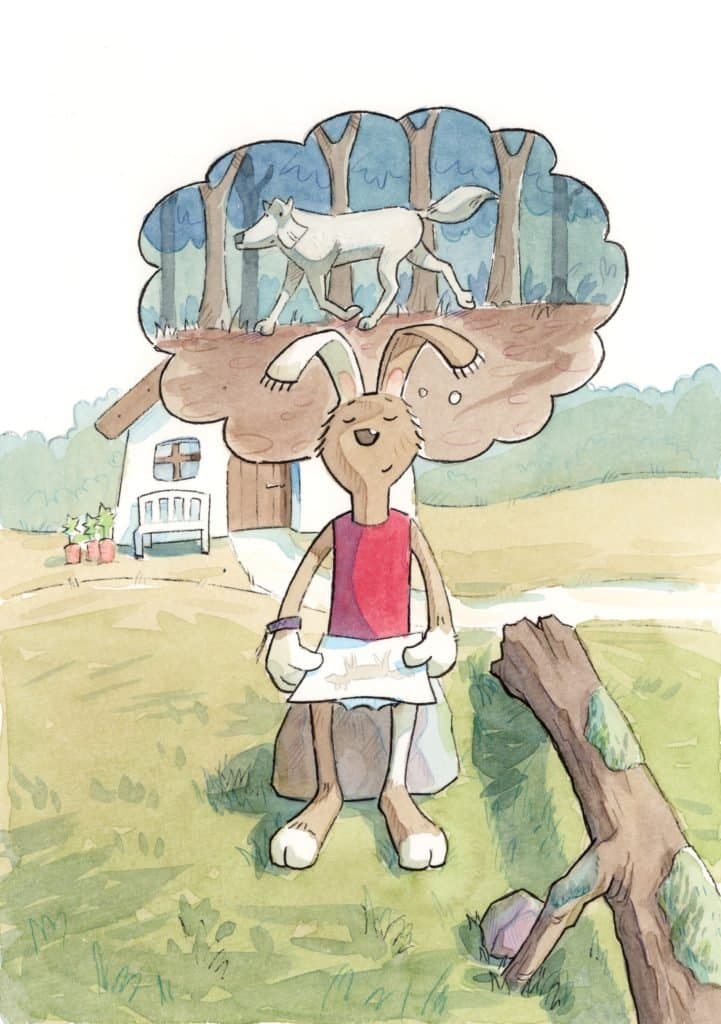
And because so many dreamy kids have vivid imaginations, can put themselves in other people's shoes, and love stories, we wrapped our best strategies up in an adventure. In it, ten-year-old bunny girl Lotte meets the wise wolf Sakiba, who teaches her the art of the wolf gaze: the ability to arrive fully in the here and now and deliberately focus on a task. At the same time, the wolf knows the value of dreaming and encourages Lotte to make peace with that side of her personality and hold on to it. Let's look at a few ways to help.
Parents, put a cap on study time!
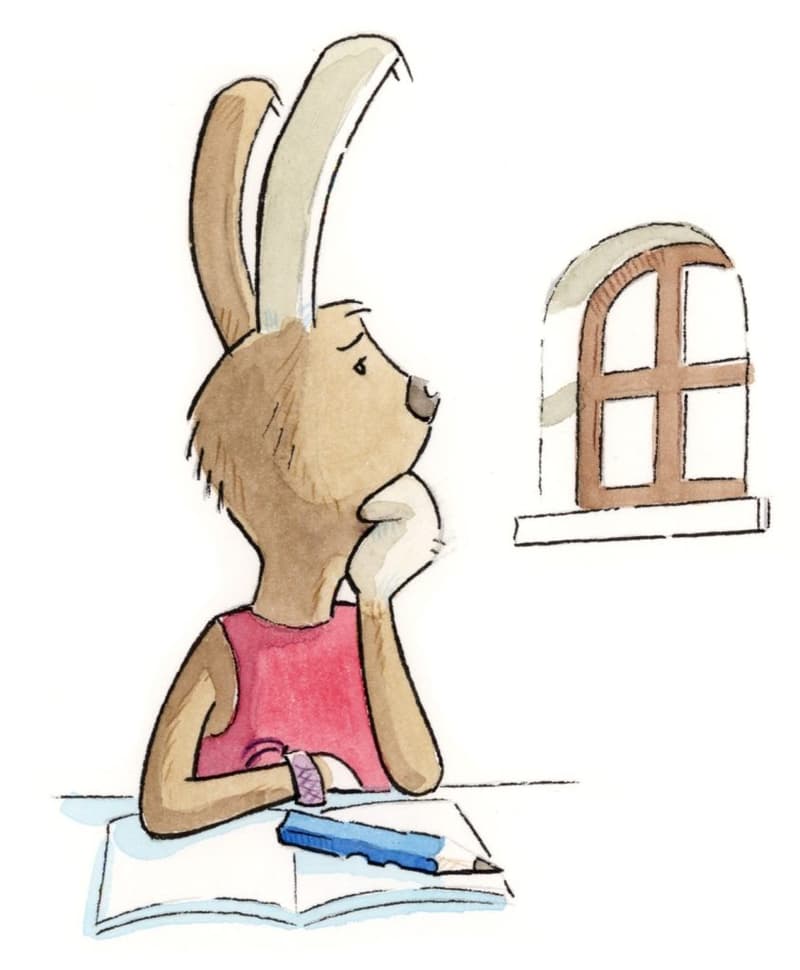
Lotte is in the same boat as most dreamy kids: she sits at her homework for hours and has hardly any time left to see her friends or to do what she loves most, drawing.
Only when Lotte's mother and her teacher realize how much Lotte is suffering do the adults put their heads together and limit the homework time. Mama Bunny tells Lotte: "Here's how we're doing it today, the way I talked about with your teacher: half an hour of homework, and you can take a short break every ten minutes. Do you want to start now, or rest a little first?"
With a time limit and regular short breaks, homework stays manageable for dreamy kids. They don't see a giant mountain that paralyzes them. Instead, they often get ambitious about making as much progress as they can in the limited time.
Important:
- During breaks, your child shouldn't get absorbed in something else, just give their head a short rest: have a drink, move around a little, listen to a song, or take a few deep breaths at an open window.
- So your child doesn't just sit out the agreed time, the rule is: I work with focus for x minutes. If your child drifts off, you can walk over, stop the timer, and ask: "Do you want to keep going, or do you need a break now?"
- The time limit shouldn't be used as leverage ("You have to get it done in this time!"). It's there to protect against overload ("That's enough for today. You're allowed to stop. I'll write your teacher a note in your homework notebook.")
Create and respect blocks of free time
Lotte looks up from her drawing and proudly holds her sketchpad out to her mother. "Look, a stag beetle!"
Mama Bunny glances at it and says, "That turned out pretty."
Lotte smiles and keeps drawing. But Mama Bunny peeks at her watch and takes a deep breath. "Actually, we agreed that you'd practice for next week's spelling dictation today."
To find resonance, to give themselves fully to something, dreamy kids don't need instructions. But they do need blocks of free time.
A sentence like "we still have to read" or "do you remember you have a test the day after tomorrow" almost instantly kills the restorative value of an activity and makes learning seem even more unpleasant. It's like having your boss call you a few times over the weekend to get you "in the mood" for next week's tasks.
Sentences like "now you can do whatever you want until dinner" or "What would you like to do today that's fun? Come on, let's see how we can fit the homework in around it" take the weight off. If your child has to do homework by 5 p.m. at the latest, remind them at 4:45 p.m. with something like: "You can finish playing for another 15 minutes, and then it's homework time." It only gets harder for them if you nag them about it every half hour starting at 2 p.m.
Practice the wolf gaze with your child
Kids don't notice when they're dreaming. So it doesn't help to keep pointing out that they're "not listening again" and are "never paying attention." Instead, we can explore with our child what concentration feels like, how to focus on purpose, and how to remember to do it at the right moment.
Lotte learns about the wolf gaze from Sakiba.
"A wolf has to be completely present. He has to see everything, hear everything. In his head there is nothing but the task he has chosen."
Lotte practices by setting a goal on purpose, reminding herself what her task is, and giving herself a clear start signal inside her head:
"Okay, full concentration! Wolf gaze on! One with the task!" Lotte says to herself, and reads the instructions on her language arts worksheet: Underline all the adjectives. "Underline adjectives," Lotte mutters, and gets going, while her mother drinks coffee and flips through her magazine.
For many dreamy kids, the command "Concentrate!" is very abstract and has negative baggage. It's often easier for them to get into a focused state when it's tied to a symbol or when they can slip into a role. That could be a superhero laser focus, or a "Spotlight on!" command, where the child imagines their attention gathering together and aiming at one task.
Listen more, talk less
Pictures like these help even adults. In continuing-education courses, teachers often tell us how hard it is for them to listen patiently in parent-teacher conferences instead of overloading parents with information, feedback, and tips. Many of them found it helpful to imagine their ear growing huge at the start of the conversation and their mouth shrinking tiny, as a reminder to listen more and talk less.
As a next step, you can think with your child about where and when they'd like to use the wolf gaze, and celebrate with them every time it works."
Fabian Grolimund and Stefanie Rietzler are psychologists who run the Academy for Learning Coaching in Zurich. They are the authors of several books (Clever lernen, "Smart Learning"; Erfolgreich lernen mit ADHS, "Learning Successfully with ADHD"*). Their newest book, Lotte, träumst du schon wieder?* ("Lotte, Are You Daydreaming Again?"), is aimed at dreamy elementary school kids and their parents. It came out this September from Hogrefe and is available in German.
*Affiliate links
This story first appeared in German on StadtLandMama.