One F in Math, and Suddenly You're Picturing Their Future
Your kid brings home an F, and by dinner you've pictured them without a job. Here's how to stop your mind from writing the whole story.
Hi friends, Jennifer Koslik is a licensed psychotherapist, and for a while now she's been noticing a pattern in parents: catastrophizing. Every day she sees women dealing with guilt, overwhelm, mental load, mixed feelings, and the nagging question of whether they're "good moms" at all. And then their kid makes one little misstep and suddenly the whole future is up for debate. Not in real life, but in the mom's head… Here (and, by the way, on Instagram too) she writes about it:
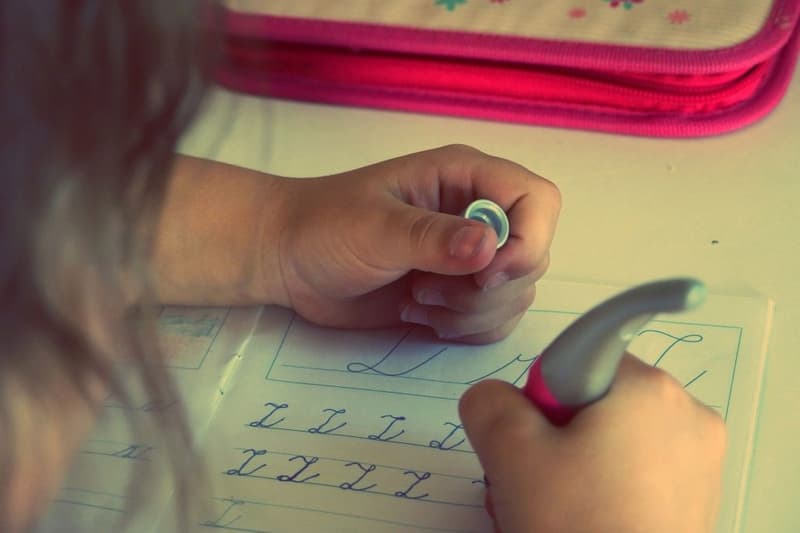
Sound familiar? One thing happens, and within seconds your mind has already jumped to the catastrophe. Your kid brings home an F in math. And suddenly you're not just thinking, "Okay, math isn't going well right now." You're thinking: "If this keeps up, they won't make it through school. Then they won't get an apprenticeship. What is going to become of them?"
Or your kid tells you someone picked on them at recess. And your mind races ahead: "What if they're being bullied? What if they become an outcast? What if they never find real friends?" With a little distance, we sometimes notice how big that leap was. In the moment, though, it doesn't feel exaggerated. It feels real.
A Thought Pattern Called Catastrophizing

When a possibility suddenly becomes a certainty: In cognitive behavioral therapy, we call this thought pattern catastrophizing. It's one of what are known as thinking errors: typical patterns that make us judge situations in a skewed way, often without realizing we're interpreting at all. Something real happens. But our mind doesn't stay there. It keeps spinning the story forward. "My kid got an F" becomes "My kid is going to fail at school."
"My kid got picked on today" becomes "My kid is going to have no friends." Somewhere along the way, a possible outcome quietly turns into a felt certainty. So maybe the key question isn't, "Could this happen?" In theory, lots of things could happen. A more helpful question is: "How many steps have I already taken in my head, without knowing whether things are even headed in that direction?"
Why does our mind do this? Because our brain is trying to spot danger early. And when it comes to our kids, that warning system can be especially sensitive. We love them, we feel responsible, and we don't want to miss anything important. The stronger our fear, the harder it can get to tell "This could happen" from "This will happen." Then we're no longer reacting only to what's in front of us, but also to the future our mind has already drafted.
Sometimes it's worth looking through your own glasses. Our judgments don't form in a vacuum, apart from what we've learned and lived ourselves. That doesn't mean there has to be an old wound behind every catastrophic thought. But it can be worth asking, with some curiosity:
Why does this hit me so hard? Were bad grades tied to pressure when I was a kid? Do I know that feeling of not belonging myself? Are my own expectations or core beliefs playing a part? Maybe. Maybe not. This isn't about forcing an explanation out of your past. It's about checking whether your own story is chiming in right now. Because our child isn't us. And their story doesn't have to continue the way ours did.
Why This Matters for Your Relationship
Thoughts influence feelings. And feelings influence our behavior. If I think, "My kid is struggling in math right now," I can stay curious: What was hard? Do they need help? But if I think, "My kid is going to fail at school," suddenly a lot more is riding on that one grade.
Maybe I start checking up more, pushing harder, or putting on more pressure. That's how a fear can begin to shape the relationship. A kid might eventually learn: "Mistakes are dangerous." Or even: "When something goes wrong, I'd rather not tell." And we only wanted to protect them.
How do I get out of the thought spiral? Recognizing catastrophizing doesn't mean brushing problems off. Behavioral therapy doesn't mean saying, "Oh, it'll be fine." It's about making a little room again between fact and fear. Four questions can help:
- What do I actually know?
- What am I afraid of?
- What other realistic outcomes are possible?
- Why does this hit me so hard right now? Are my own experiences,
expectations, or core beliefs playing a part?
With the F, that looks like this: I know my kid got an F. I'm afraid they'll fall behind and fail at school later on. But it's also possible that this topic was hard, that they didn't study enough, or that my kid needs some support. And suddenly you can see it again:

My fear makes sense. But it isn't a prediction yet. Sometimes in therapy we take it one step further. Sometimes we deliberately follow a catastrophic thought all the way to its end. "My kid got an F." "Maybe they'll get more bad grades." "Maybe they won't make it through school." "Maybe they won't get an apprenticeship."
And eventually we land at: "My kid will never stand on their own two feet." This isn't meant to make the worry look silly. It shows how many unproven assumptions sit between what actually happened and the catastrophe we fear. Then we can check:
How likely is each individual step? What other paths would be possible? And even if something difficult did happen: What options would my child and I have then? Because when we catastrophize, we often overestimate how likely the worst outcome is, and at the same time underestimate our ability to cope with difficulties.
What does my kid need today? So maybe a different question is more helpful than "What if this turns into something terrible?" Namely: "What does this specific situation need from me today?" Not in five years. Not in the worst version of my imagination. Today.
Maybe my kid needs help with math. Maybe after a conflict they need someone to listen. And maybe we parents need a moment to notice: My mind is trying to protect me right now. But that doesn't mean I have to believe every thought it throws at me. Because a thought isn't a fact. A worry isn't a forecast.
And just because my mind has already told the story all the way to the end doesn't mean life will write it that way.
This story first appeared in German on StadtLandMama.