Is Your Child Being Bullied in the Group Chat? What to Watch For
Heads-up: This post contains affiliate links. If you buy something through them, we may earn a small commission at no extra cost to you. As an Amazon Associate, we earn from qualifying purchases.
Your kid is quiet, glued to the phone, or suddenly avoiding it. A social worker tells us what's really going on in the group chat, and what to say.
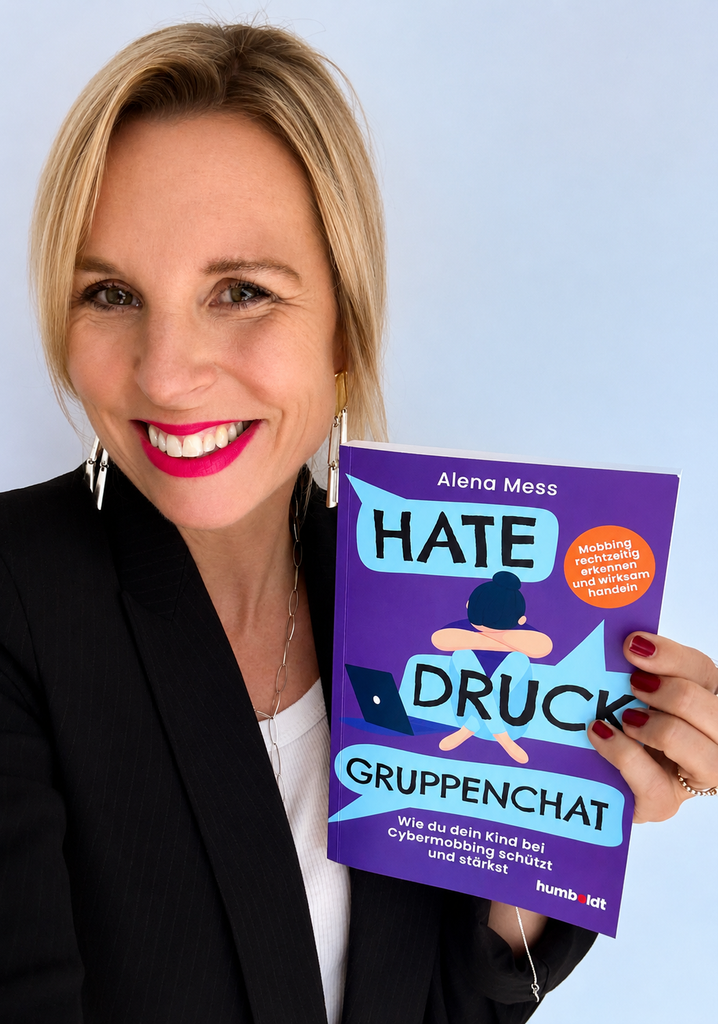
Hi, friends! We get so many messages about bullying. And cyberbullying is its own beast: it mostly happens quietly, and it's often hard for parents to spot. In her book Hate, Druck, Gruppenchat (in English, "Hate, Pressure, Group Chat"), social worker Alena Mess explains in plain terms, and without scaremongering, what dynamics are behind it, how peer pressure works, and how digital content like fake nudes or deepfakes can quickly turn into bullying.
She helps us catch warning signs early, and she shows why kids who are being targeted so often stay silent: out of shame, fear, or because they can't make sense of what's happening to them. She also offers concrete ideas for protecting our kids without controlling or shaming them. It's not only about handling an acute crisis. It's also about media literacy, a clear stance on digital boundary-crossing, and building our kids' self-worth.
Alena Mess has 20 years of experience in child and adolescent psychiatry, in child and youth welfare services, and working with violent and sexual offenders. She counsels bullying victims as well as victims of sexual violence and their families. She's also an expert witness for family court, and for many years she has been a speaker on abuse imagery and sexual violence for Germany's state and federal criminal police agencies (the LKA and BKA, roughly comparable to state police investigators and the FBI), as well as at schools, daycares, and child and youth welfare organizations. She advises kids, parents, and professionals.
Dear Alena, why does it seem to give some kids and teens so much satisfaction to put others down and build themselves up? Why do they need that separation, and what's behind it?
Kids and teens who put others down often want to feel bigger themselves. Behind it there can be low self-worth, insecurity, or the fear of becoming a target themselves. Some have felt firsthand what it's like to be excluded, put down, or powerless, and they flip that feeling around:
Someone who controls others doesn't feel helpless for a moment. In a group, something else comes into play: when others laugh along, like a post, or join in, it quickly creates a sense of power, recognition, and belonging. That can explain the behavior, but it doesn't excuse it.
Why do some kids have a hard time accepting that someone is different? Why is it so quick to "That kid is weird"?
Being different can feel unsettling. Kids and teens compare themselves with each other constantly: How do I look? What am I wearing? Who do I like? What can I do, and what can everyone else do? When you don't feel sure of yourself yet, differences can feel less like something that enriches you and more like a threat. Then it can seem easier to slap a "weird" label on someone than to deal with something unfamiliar.
On top of that, there's the pressure to fit in with your own group. When a clique has certain rules, like how you're supposed to look, talk, or react, anyone who strays from them gets put down fast. That's exactly why kids need adults who clearly speak up when exclusion is passed off as normal, and who don't just claim to value diversity but live it in everyday life.
Some kids don't realize where bullying starts, or what "It was just a joke!" can do to the person on the other end. How can we make kids more sensitive to this?
Kids have to learn to look not only at their own intention but at the effect on the other person: How is that person doing right now? Are they really laughing along, or only laughing so it doesn't get worse? What happens when a photo gets forwarded, a put-down gets repeated, or someone is pointedly kicked out of the chat?
You can practice this in concrete ways: talk through situations from school or group chats together, switch roles, and ask, "How would that feel for you?" It's also important to give kids the words for boundaries: "Stop," "Delete that," "That's not funny," "I'm not going along with this."
And they need to hear the clear message: if you don't laugh, don't forward it, and don't look away, you can have someone's back. A joke is only a joke if everyone can laugh about it. When a child is hurt, shamed, or excluded, a line has been crossed.
If I notice my child is down: what approach do you think works best to get them to open up and tell me about a crummy situation in a chat?

Not every change is "just the teen years." Parents should pay attention if a child suddenly withdraws, doesn't want to go to school anymore, sleeps worse, seems more irritable or unusually quiet, has stomachaches or headaches, checks their phone in a panic, or suddenly doesn't want to touch it at all. Changes in eating, dropping grades, or pulling away from friends can also be signals.
Then it helps to open a door without interrogating your child: "You've seemed different lately. I'm wondering if something is weighing on you, maybe at school or in a chat." Don't jump in right away with solutions, a phone ban, or confronting the group.
Many kids stay silent out of shame, loyalty to their clique, or fear that adults will take over everything and make it worse. What matters most is the promise: "You won't get in trouble if something awful happens to you online. We'll figure out together what helps you now."
Why is fitting in with the peer group such a make-or-break thing at this age?
As kids get older, the group becomes, alongside the family, a central place for belonging, recognition, and direction. That's where kids and teens try out their identity: Who am I? How do I come across to others? Who do I want to be connected to? Feedback from peers carries especially heavy weight because of that.
Kids who belong experience validation, protection, and social security. Kids who are excluded lose more than a playgroup or a chat: very often, their sense of being accepted and valued as a person starts to wobble. And precisely because the group matters so much, many kids stay in hurtful dynamics, laugh along, or tell no one, out of fear of losing their place themselves.
Online, it gets worse: the group is always there through chats, likes, and stories, and exclusion doesn't necessarily end when the school day does. Bullying can therefore weigh on kids deeply and make withdrawal, anxiety, sleep problems, or symptoms of depression worse.
How can we build our kids up when it comes to social media and messaging apps, and in life, of course?

Kids don't need constant monitoring. They need reliable adults who stay interested and are easy to talk to. They should know: I'm allowed to say no. I don't have to post, send, or forward anything. I don't have to laugh along to belong. And I'm allowed to get help without being to blame.
That means talking about concrete situations early and regularly, not only after something has already happened. Parents can ask: "What's going on in your chats?" "What would you do if someone sent around an embarrassing picture?" or "How can you help without putting yourself in danger?" Kids also need practical steps they can take: save the evidence, don't write back, block, report, and bring in a trusted adult.
Digital courage matters too, meaning the willingness to speak up online. Kids can learn not to forward hurtful content, not to join in with emojis or likes, and to message the person targeted privately: "I saw that. It wasn't okay. I'm here." Even one person visibly not taking part can change a group's dynamic.
The digital world isn't inherently bad. But in a chat, facial expressions, tone of voice, and the other person's immediate reaction are missing. At the same time, there's an audience, screenshots, forwarding, and constant availability. A cruel comment can follow a child right into their bedroom and keep resurfacing. That makes clear rules, media literacy, and adults who model how to talk about other people, online and off, all the more important.
This story first appeared in German on StadtLandMama.