
Should I Stay or Should I Go? Couples Coaches Weigh In
Heads-up: This post contains affiliate links. If you buy something through them, we may earn a small commission at no extra cost to you. As an Amazon Associate, we earn from qualifying purchases.
Is it exhaustion, or is it over? Two couples coaches explain why so many of us stay quiet for years, and what to ask before deciding.
Hi friends, how do we stay happy in a long-term relationship? What questions can we ask our relationship to find out whether we still want all of this… or maybe don't anymore? Dagmar Kieselbach and Thomas Hallet help us sort through those thoughts in their book “Should I stay or should I go” and make a possible decision a little easier. They've written twenty questions we can ask our relationship to see whether we should leave or stay. In this interview, they also share plenty of good, practical advice.
You two are a long-term couple who coach other long-term couples. How much of what you learn in those sessions carries over into your own relationship?
Every couple is so individual that you can't take what you learn from other relationships and apply it one-to-one to your own. And we don't. But because we spend so much time immersed in relationship issues, we're very alert to what's happening between us. That doesn't mean we don't fight or never have conflict. We do. The difference is more that our inner alarm bells go off earlier. We spot patterns faster, and we usually find our way out faster, too. So our work makes us more sensitive to the typical problem patterns.
Many couples come to you after an affair, or, as you call it, an outside relationship, because it hits everyone involved so hard. How can you help in a concrete way?
An affair that comes to light is a massive shock to a partnership. It pulls the ground out from under both people, though in very different ways. Suddenly there's hurt, betrayal, anger, shame, guilt, fear of loss. Without support, a lot of couples can hardly bear all of that.
So our first job is to help couples sort through that emotional chaos. The hurt has to be seen before any healing is possible. Only later do we get to understanding why it happened, whether a fresh start is possible, and how trust can grow again.
Your book is called “Should I Stay or Should I Go” because you say a lot of people ask themselves that in midlife. Why is that?
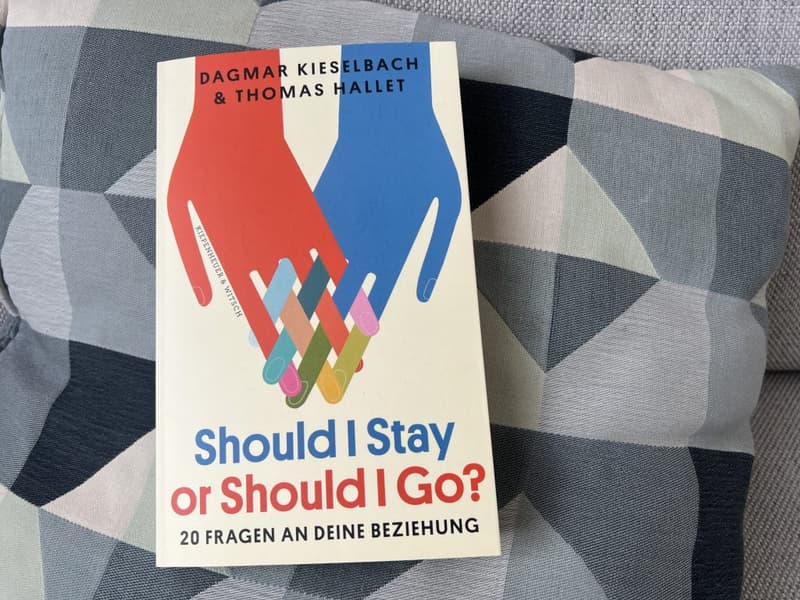
Should I stay or should I go? Lots of people in long relationships ask themselves this. Often it goes unspoken, quiet, sometimes for years. It usually doesn't come from one single event but from a deep inner exhaustion. When conversations go in circles, when closeness slips away, when hurts pile up. In midlife especially, several things often come together at once.
Many of the outside circumstances that carried a relationship for a long time change or fall away. The kids become independent, careers are established. That opens up room for questions that had hardly any space before. “Is this it, or is there something more?” You look at your own life differently, at closeness, at wishes that went unmet. It's not that the relationship is bad. It's that it's no longer growing. And what growth could look like isn't clear.
You've probably heard the one about the frog: it hops right out of a pot of very hot water, but if the water warms up slowly, it stays put, never makes its escape, and slowly dies…
The couples who come to us for counseling are generally not couples who just sit passively in the pot. They're couples who want to change something and who feel they can't go on like this. But there are definitely also many couples who don't really notice that they're slowly but steadily drifting apart.
Closeness fades bit by bit, dissatisfaction grows. Many couples settle surprisingly comfortably into a state that actually makes them unhappy. At some point that unhappiness becomes familiar. And then the relationship may end up like the poor frog. That's why honest questions matter so much. To your partner, but also to yourself: Are you actually still content? Gritting your teeth is not a relationship strategy.
If there's no violence in a long-term relationship and it has just somehow become boring, and you're living together more like roommates than lovers, how do you get the spark back?
It's less about lighting a big fire again and more about striking small sparks. Rediscovering good conversation, real closeness, attention, and a lighter mood. Being in love all the time isn't a realistic goal. But energy, connection, and desire can come back again and again.
To get there, you need the courage to leave your ruts and try something new. For example, saying what you want, sharing your insecurities, and letting your partner surprise you. And finally, it's about curiosity. Not assuming you already know everything about the other person after all the years you've been together. Desire and aliveness come up when you can discover your partner from a new angle.
You like to have couples tell you what they fell in love with in each other at the beginning. And you say that if someone can't remember, that's already a sign it may be coming to an end, right?
The idea behind asking about the beginning of a relationship is mainly that the couple remembers that falling-in-love phase. And reminds themselves why they were so taken with each other back then. Many of the couples we work with can reconnect spontaneously over this question, and it relaxes a conversation that's often strained. But we don't agree with the reverse: that someone who can't remember has a poor prognosis. Working with that couple is certainly not easier, but it's not without hope.

At what point do you say a relationship is worth fighting for? And when do you say a separation might be the right call?
We struggle with the word “fight.” It suggests that one person alone could save something. It's more about asking questions: What's missing for me in my relationship? What can I do myself to change and improve that? What still connects us? What reasons are there to stay together? What would I like more of, and what less?
In our counseling, we often see that thoughts of separation and threats to leave cover up questions like these and do damage to a relationship that's already stressed. By the way, we never tell a couple, “A separation would be right.” But it does become more likely when one of them drops out of the conversation and doesn't want any change. When one of them would rather stay stuck where they are.
What question can I ask my relationship if I'm thinking: My partner is great, but right now I'm eyeing all the newly-in-love people around me with a little envy, the ones on their second go-round who are feeling that spark all over again and being treated like royalty?
A good question might be: What do I actually want for my own relationship? What am I unhappy with? Do I feel like we're stagnating? Being newly in love is definitely a rush and always a wonderful phase of a relationship. But then come other phases that challenge a couple to keep their relationship alive. Falling in love happens on its own. But for love, you have to keep your relationship in view and shape it every day.
Why do so many people stay in relationships that aren't good for them?
It's a phenomenon we see in many forms in our counseling. We often hear: “We've grown apart.” But how can a couple change that? Change takes energy. It seems easier and more comfortable to let everything run along as it is, nag, and withdraw. Many couples resign themselves to things not going well anymore, and maybe figure that a long-term relationship gradually falls apart on its own.
In counseling, we then ask what the two of them still have in common and what they're willing to do to get it back. But many also come to us pretty lost, because they don't know how to get out of their constant fights. Or how to talk with each other better again. They come to us because they hope we can support them with that.
But why are there also more breakups than ever, and yet people are still getting married left and right? Do we just want to believe in everlasting happiness with the ONE person?
Yes, that's true for many people. The romantic love relationship is still an ideal that's deeply rooted in our society and our culture. Everlasting happiness with exactly this chosen person is a lovely prospect, after all. In our very crisis-prone times, we think it's especially tempting, because a partnership promises not only lightness and aliveness, but also stability and control over our own life circumstances.
This story first appeared in German on StadtLandMama.