Inside a Children's Hospice, Where Marie's Laugh Fills the Room
Marie can't walk or eat, but her laugh shakes the whole room. See what a children's hospice means to her, her parents, and her brother and sister.
Marie Richter is 13 years old and is considered to have “severe multiple disabilities.” We’re telling her story to explain what that means, what her triplet siblings think about it, and why she feels so at home in a children’s hospice.
By Lisa Harmann and Annette Etges
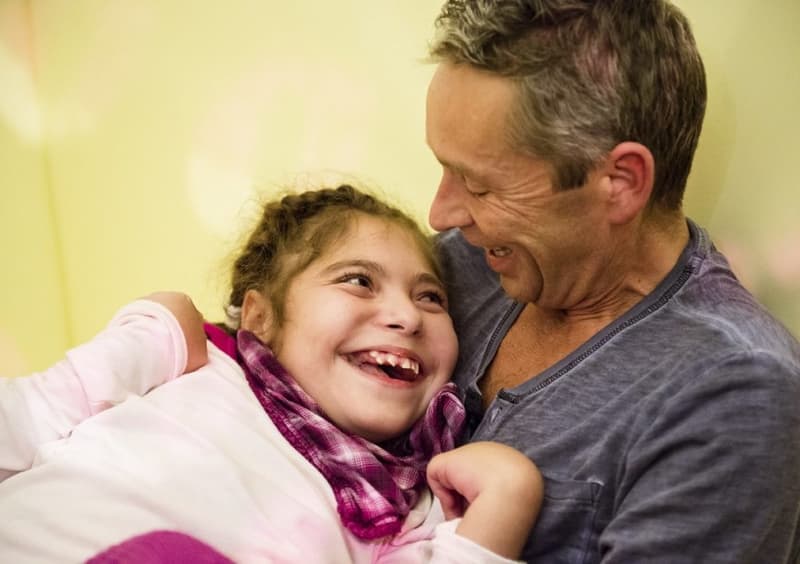
Marie’s laugh is contagious. When she laughs, her whole body shakes and everyone around her laughs along. Marie is a very special person, and she needs help from others around the clock. She sits in a wheelchair with chameleon stickers on the wheels. She can barely see, but her hearing is extra sharp. When her dad or her mom says her name, she smiles happily.
We meet Marie, her siblings, and her parents, Ines and Uwe, at the Balthasar children’s and youth hospice in Olpe, Germany. A children’s hospice is a place for families who have a seriously ill child, like Marie’s family. No fewer than 4,000 children in Germany become incurably ill every year. Some of them are cared for at Balthasar.
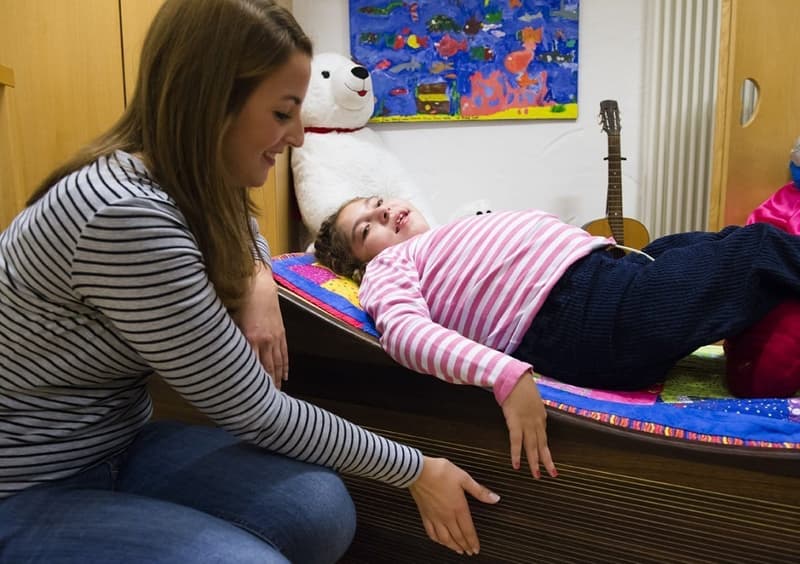
Lisa-Marie Scherer from Balthasar with Marie
From the entrance, you look out on a colorful wall of red, blue, and yellow handprints. When Marie came to Balthasar for the very first time, she got to leave her mark on the wall, too. Every child who comes here does. “The colorful handprint wall is our guest book,” says Lisa-Marie Scherer, who works at the hospice.
A hospice is a sad place? Not always!
Some people think a hospice must be a sad place because people sometimes die there. But anyone who has ever stayed at a children’s hospice knows it’s a place with a lot of laughter, which is why Marie feels so comfortable here. Hospital clowns come to cheer the kids up, colorful pictures hang on the walls, and there are lots of great games. When a child is so sick that she may die earlier than other children, she should be able to really enjoy every single day here. In the sensory room, often called a Snoezelen room, for example.
Marie loves that room. Her dad lifts her out of her wheelchair and onto the water bed in the middle of the room. She lies in his arms. Theresa and Lukas, her triplet siblings, are visiting, and they lie down with her and “chill.” The room feels a little like a sci-fi movie set. A disco ball hangs from the ceiling, casting colorful dots on the walls, a lava lamp bubbles away in soft colors by the entrance, and the lights are dimmed. Marie and her papa enjoy the gentle sloshing of the warm water beneath them. The siblings relax, too. The wonderful thing about a children’s hospice is that it’s not just the sick kids who feel good here, but the healthy ones, like Theresa and Lukas.
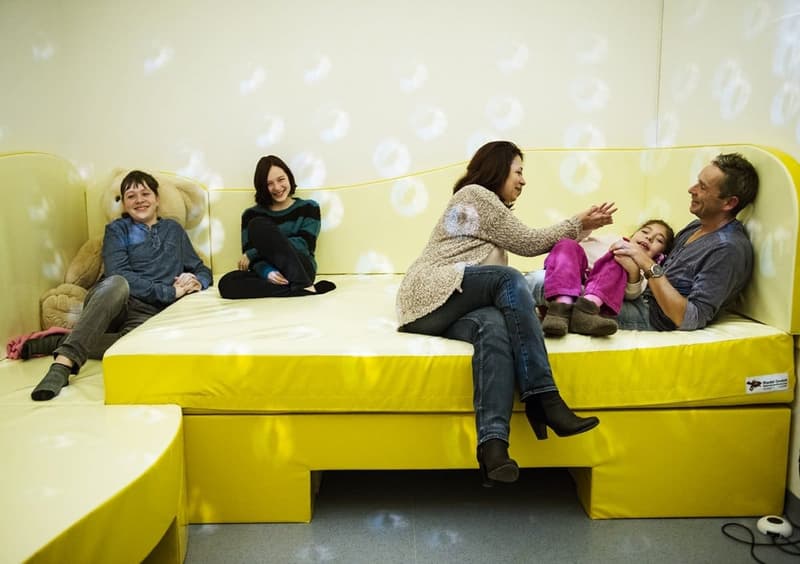
The whole family together in the sensory room
After the sensory room, Marie gets to go to the playroom. “Papa,” she says, and he carefully lifts her into the sound bed. It’s a kind of wooden rocker where you can make music on both the left and right sides. On one side you can drum with your hands, and on the other, strings are attached that sound like a guitar. The best part is that Marie feels the sound waves through the wood she’s lying on, and that helps her muscles relax. Her fingers, nails polished, stretch out long and are no longer curled into a fist. The calm only lasts until her dad drops his keys. Marie hears it and bursts into a big laugh. Everyone in the room laughs with her. Marie’s laugh comes from deep inside.
Marie is different from other kids, and she lives with a disability
Marie’s brain doesn’t work the way other kids’ brains do. She really shouldn’t be able to speak, and yet she says “Mama” and “Papa” – and “Mimi,” which is what she calls herself. Or she raises her hand to signal that she’d like to cuddle now. Marie loves to cuddle. And her siblings and parents happily take her up on it.
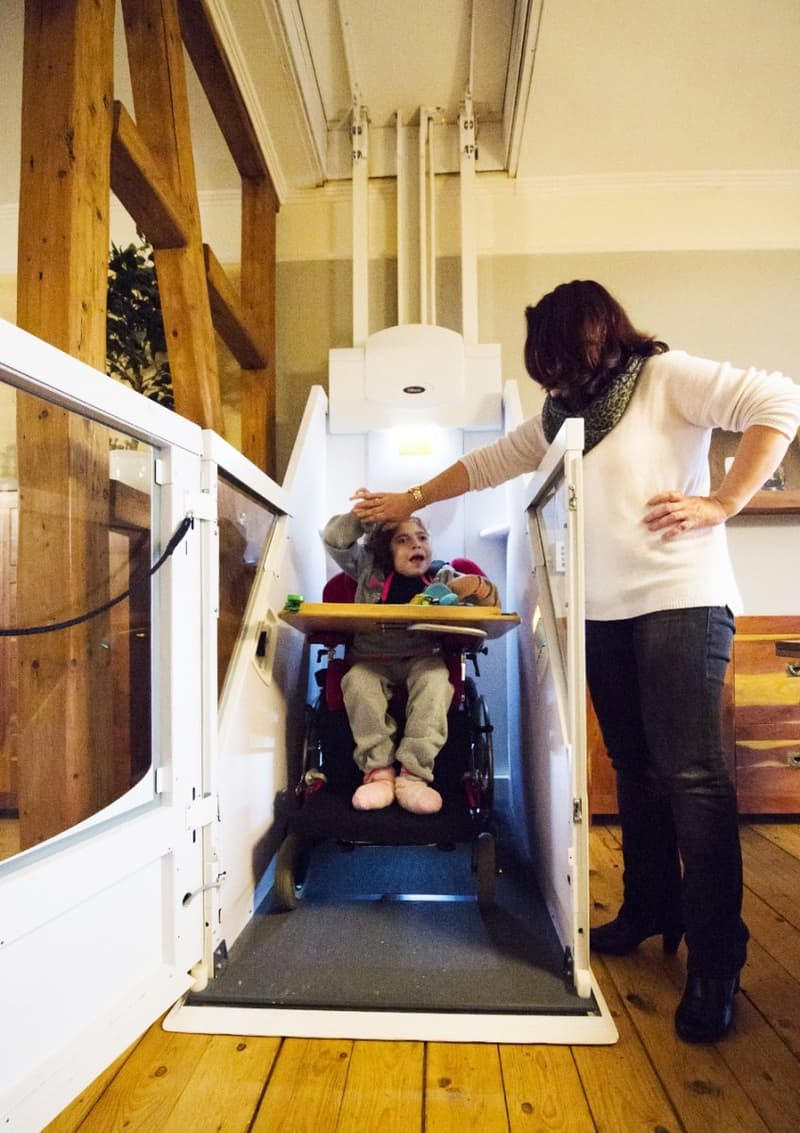
An elevator makes everyday life at home easier for Marie
Marie is allowed to stay at the children’s hospice four weeks a year, sometimes with her family, sometimes without. She can’t eat, and she gets her nutrition through a tube that goes directly into her stomach. When she goes to school in the morning – and yes, Marie goes to school, too – a caregiver goes with her. Marie also often needs medication, day and night, so someone always has to be awake to watch over her. That’s why a home nursing service helps her parents. A nurse comes to the house and takes care of Marie so her parents can sleep, too. Even so, her parents still handle 15 to 17 loads of laundry a week themselves.
The best therapy is her triplet siblings
“This is the thumb who shakes the plums down,” her father says, touching Marie’s finger (it’s the start of a German finger rhyme). She does what she likes to do best: she laughs. Next to her, another little hospice resident hops around, and a German pop song about saying thanks for the flowers plays from her small tablet: “Thank you for the flowers, thank you so much…”
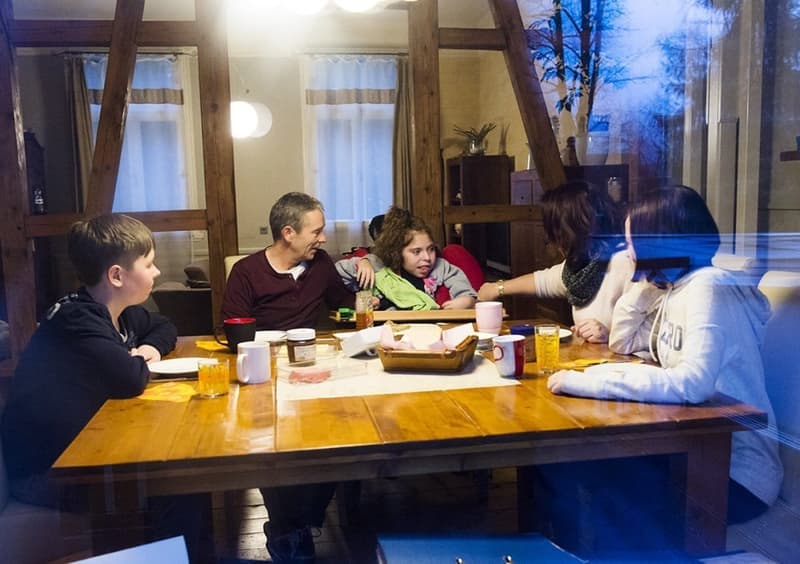
“The best therapy is that our kids are triplets,” says Ines. Marie is right in the middle of a big family, and through Theresa and Lukas she has heard the words “Papa” and “Mama” so often that she can simply say them herself, even though the doctors thought that was basically impossible. No one has been able to figure out yet exactly what illness she has.
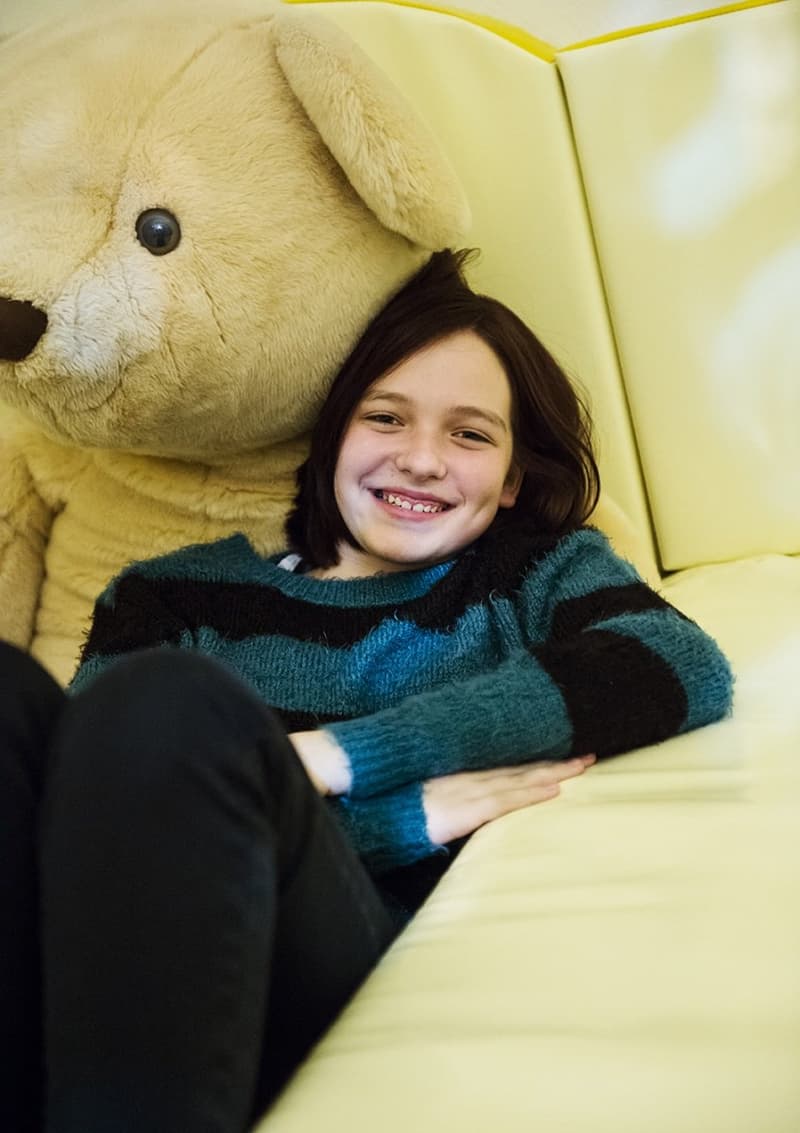
Beaming and relaxed: Theresa is Marie’s triplet sister and loves coming along to Balthasar
Marie and her siblings were born early, at 30 weeks of pregnancy, ten weeks before their due date. Lukas weighed 3 pounds, 1 ounce (1,400 grams), a little more than a carton of milk. Theresa weighed 3 pounds, 8 ounces (1,600 grams). And Marie, the third, weighed just 1 pound, 12 ounces (790 grams), less than a big can of ravioli. At first she was the strongest of the three. But at around six months, it became clear that Marie had severe brain damage and severe epilepsy. The doctors determined that Marie would never learn to walk and would always need diapers. She might not live as long as her siblings, either.
“All three are wonderful”
“You take gifts the way they come, even if a corner might be missing,” says Ines, talking about her kids. “All three are wonderful.” Marie can’t walk or eat, it’s true. But she has a very special feel for situations. She notices right away when something is off. Or when the mood is good. “We really don’t need pity!” her mom says. She calls Marie “little angel” or “little rascal.” The little angel doesn’t like it when Mom is on the phone. Then she turns into the little rascal and protests loudly. 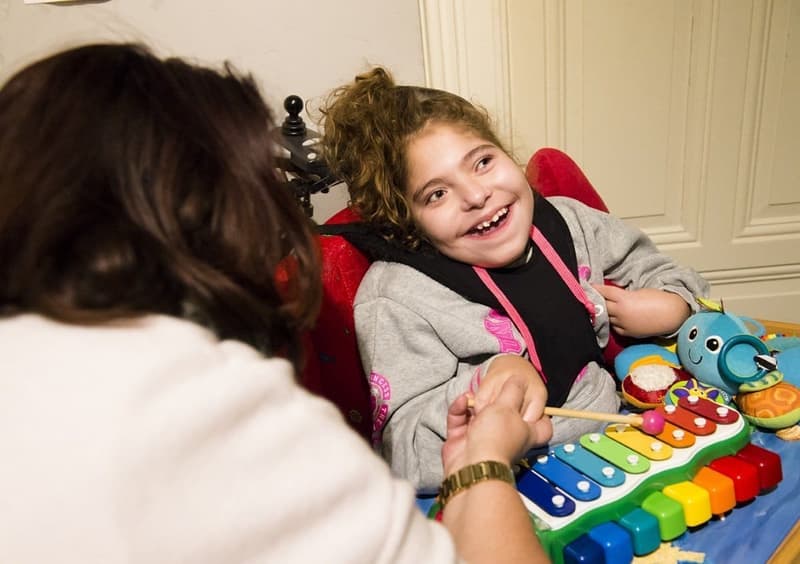
As long as she laughs: Marie enjoys her time with her family at the hospice
Lukas wants to be an entomologist someday. Theresa would like to work at an inclusive preschool, one that includes children with disabilities. Her sister shaped her. And Marie? She just wants to live! And keep laughing. Because as long as Marie laughs, everyone around her smiles.
Info box: A children’s hospice is a place where people come together. Children with incurable illnesses are cared for here. The difference from an adult hospice is that people aren’t cared for only in the final phase before death, but much earlier. A children’s hospice exists so the whole family can recharge, because life with a seriously ill child isn’t always easy. Families can be admitted if their child has an incurable illness that shortens life. Pediatric nurses, educators, and grief counselors work at the hospice. Physical and occupational therapists also come to the house when needed.
The Balthasar children’s and youth hospice in Olpe opened in 1998 as the first children’s hospice in Germany, and many who have stayed there call it a “second home.” Balthasar has eight spots in the children’s hospice and four in the youth hospice. Families with seriously ill children are entitled to 28 days a year in the children’s hospice. Anything beyond that is funded by donations. Insurance covers about 30 percent of the costs. The other 70 percent, more than 1.2 million euros a year, has to be raised through donations. Parents can also keep coming by after their child has died.
Donation account of the Balthasar children’s hospice (a German bank account):
Kinder- und Jugendhospizstiftung
Account no. 190 11
Pax Bank Köln
Bank code (BLZ) 370 601 93
BIC: GENODED1PAX
IBAN: DE 23 3706 0193 0000 0190 11
Please include your full address in the reference line so a donation receipt can be sent to you.
This story first appeared in German on StadtLandMama.