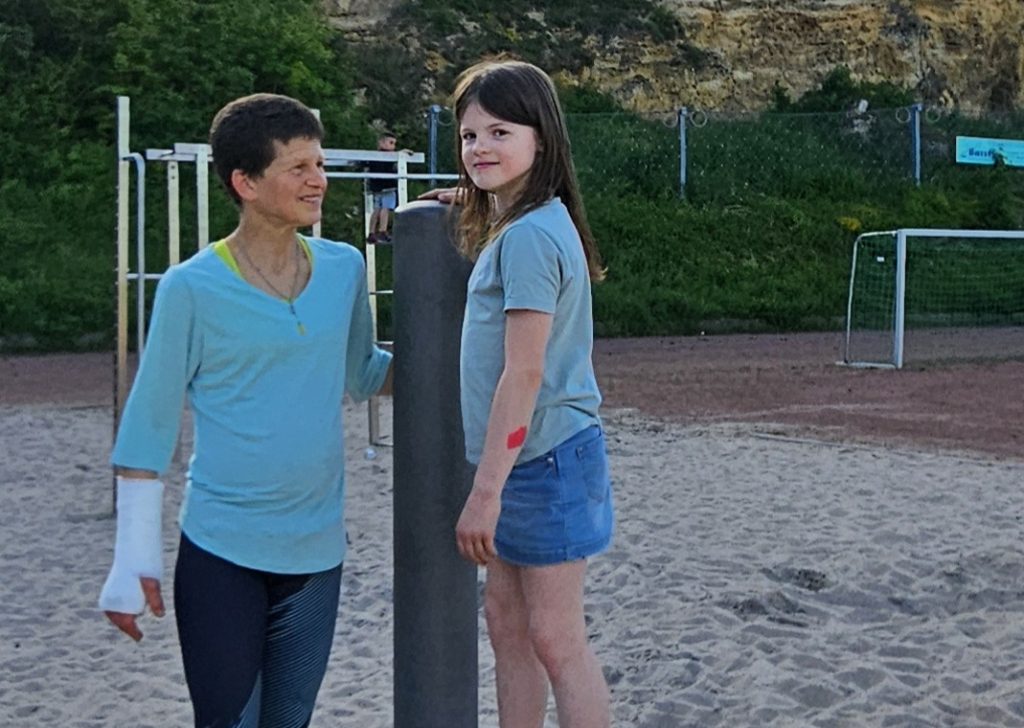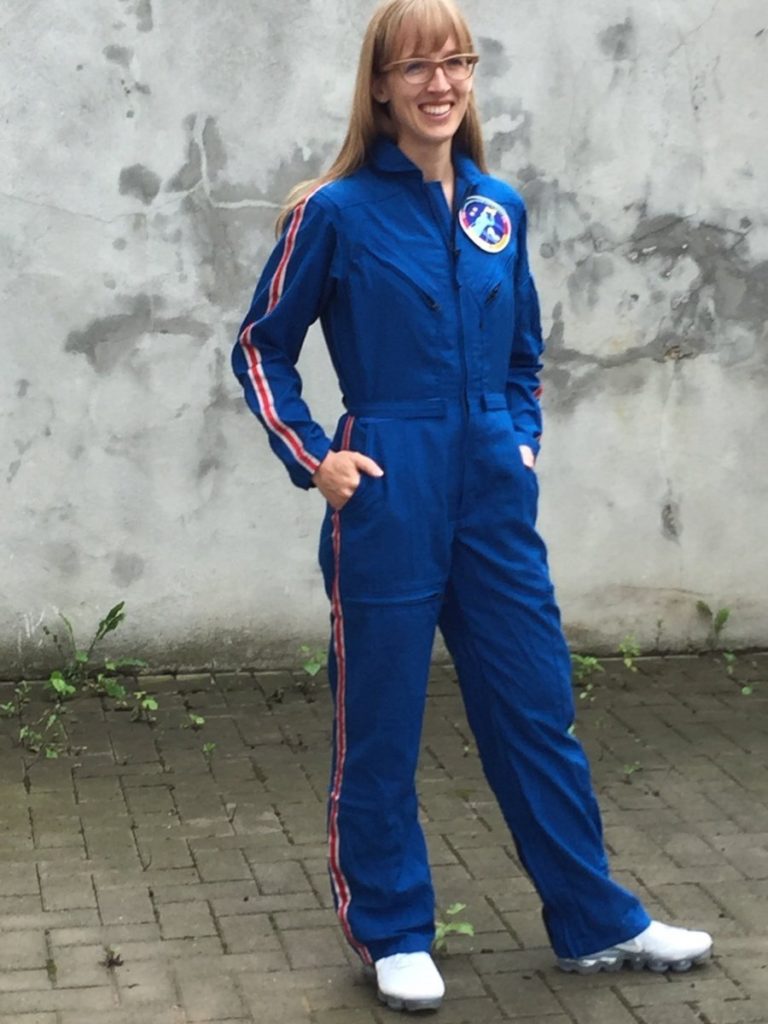
Meet the Mom Who Could Be Germany's First Woman in Space
She went back to work after two months, her girls roll into her bed at night, and she's training for space. Insa Thiele-Eich doesn't do small plans.
Insa Thiele-Eich, 34, is one of two candidates vying to become the first German woman in space, with a flight planned for 2020. We talked to the astronaut from Königswinter about how she plans to combine the mission with her job as a scientist and two little girls – and how a family bed, extended breastfeeding, and space training fit together.
By Lisa Harmann
What “time slot” should we block out for the interview? That's what Insa Thiele-Eich, 34, asks before we meet. We plan for an hour and a half, but we end up at three and a half, because when the conversation moves between heaven and earth, births and rocket launches, extended breastfeeding and weightlessness, time turns out to be pretty relative.
Almost in passing, she mentions that the next day she's not only hosting her daughter's seventh birthday party, she's also flying to Russia that evening to start the first parabolic flights of her three-year astronaut training. “Limits are made to be pushed” seems to be this woman's motto.
Right now, though, she's pretty tired. Her little family sleeps in a family bed, and last night their teeth-grinding godchild stayed over, too.
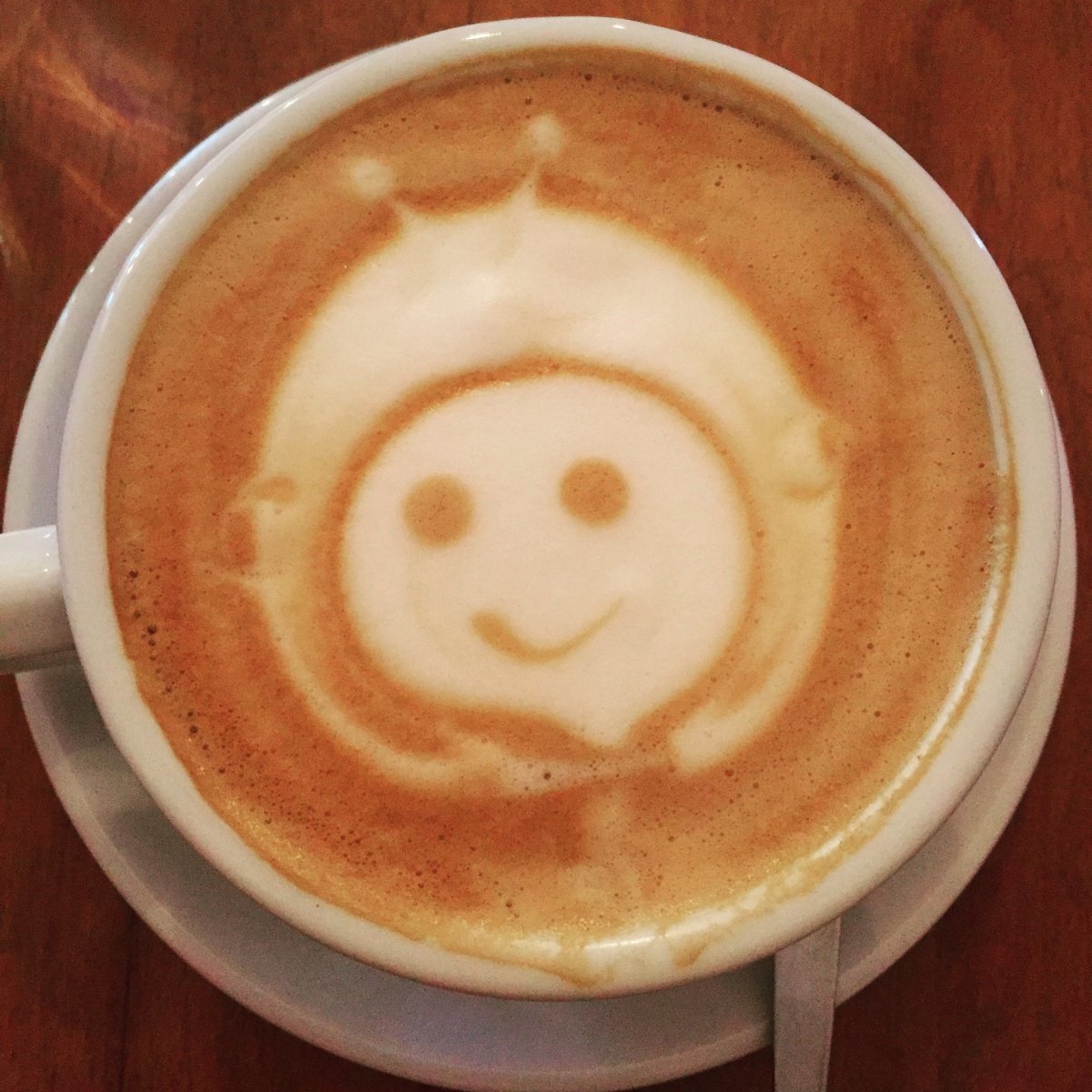
We meet at her favorite café in Bonn. Coffee first. The barista knows her – she wrote parts of her doctoral thesis here – and conjures a tiny astronaut into her milk foam.
Ms. Thiele-Eich, you're training to fly into space, yet you sleep in one bed with your husband and your daughters?
Yes, really. It works for us as a family. I don't do everything that falls under so-called attachment parenting, because I assume everybody makes the choices that are best for their child and their family, and I don't like following parenting books dogmatically. But yes, extended breastfeeding was part of our life, too. I never would have expected that. I thought you just stop after six months.
Can you actually combine this kind of attachment-focused parenting with a full-time job?
I went back to work two months after the birth. My husband took a year of parental leave. But that's also a reason for the family bed. The kids don't see me that much during the day – and at night, two little bodies roll over to me. That shows me how important it is for me to meet their need for closeness at night.
Of course my husband and I would love to have more time for ourselves in the evenings. But I can't be at the school door at lunchtime to pick the kids up, like other moms can, so this is how we do it.
How did the people around you react to your quick return to work?
With “Oh my God.” A lot. In my postnatal recovery class, people felt sorry for me. At my lactation consultant's office, someone suggested I could just take out a loan instead of going to work. I had to stand my ground pretty firmly when I said: I'm going back to work full-time, I'm still breastfeeding, and I'm pumping. I mean, her dad was home with her!
So saying goodbye wasn't hard for you?
Well, on my first day back, I should have worn waterproof mascara, and I found the pumping annoying, too. Still, overall it felt right for us.
Now parabolic flights, scuba courses, and a pilot's license are coming up …
Yes, the training takes three years. I'll keep working as a scientist, but I've cut back my hours. In two years we'll know which of the two of us will fly and which one will serve as the backup.
My father was an astronaut, too, and he waited twelve years before he finally got to fly himself. We'll only be on the International Space Station (ISS) for two weeks, so the kids won't have to do without me for very long.
On parabolic flights, the plane climbs very steeply and then dives, which creates a brief moment of weightlessness at the top. Doesn't that make you sick?
Oh, I've done parabolic flights before. I handle it well, and I actually find it exciting. I didn't get nauseous during my pregnancies, either.
Are there any rules, like a ban on getting pregnant?
Nothing specific. But I think right now wouldn't be the best time for a pregnancy. In the first months with a newborn, the baby's needs come first. But I'm still young, so who knows what comes after.
Why do you want to go to space?
Out of scientific curiosity. I'm looking forward to all the different experiments we can do on the ISS. Some of them in biology, for example, like how female hormones react to weightlessness.
So it's not mainly about the fact that it's high time a woman went to space?
Honestly, I always wanted to be an astronaut. I'm surprised myself that in 2017 it's still possible to be the first German woman in space. That's the one part of my job I embrace wholeheartedly. It drives me crazy that when I plan a space-themed birthday party for kids, the only astronaut decorations I can buy are little male astronauts.
You want to pave the way?
If I can use the attention we're getting now to change something, I'll gladly take it. I want to show my kids that moms can change tires, too. And that not every girl has to find STEM – science, technology, engineering, and math – boring. Because it's incredibly exciting.
Are you taking a cue from German astronaut Alexander Gerst, who shared his trip to the ISS in fall 2014 so publicly?
Absolutely! He reached so many people with his photos and posts from space! I think that's great, because space travel is really very emotional.
How so?
It's about pushing past limits. I once read that only ten percent of people ever go to their limit. So 90 percent would rather not. They warned Christopher Columbus, too: Are you nuts? You'll fall off the edge of the Earth. Back then, people still thought the Earth was flat. But as we know, he set out anyway. Only 550 people have been to space so far – that's not very many. So I think it's important to pass on what we learn to everyone else.
Do you ever scare yourself with your own nerve?
Of course. You fly into space instead of just mowing the lawn at home for once (laughs). I also tend to host sleepovers for the kids right in the middle of very stressful phases.
But seriously: sometimes I think, of course, how relaxing it would be not to always have new plans. But then that wouldn't be me. We try to keep the kids in childcare for no more than 35 hours a week, and my husband transferred internally so he could work from home more often.
We could also imagine getting an au pair at some point. And we have a great network of friends: sometimes one takes the kids, sometimes another. Then you don't feel quite so guilty.
Are you ever afraid of what's ahead of you?
That too. Though I see fear – just like guilt – as a healthy ingredient. It makes us double-check: Do I know all the risks? Did I miss anything? For example, I'm very careful with the kids around water, because I'm not a lifeguard and can't judge the risk. And I know from the history of space travel that everything possible is done to learn from past mistakes.
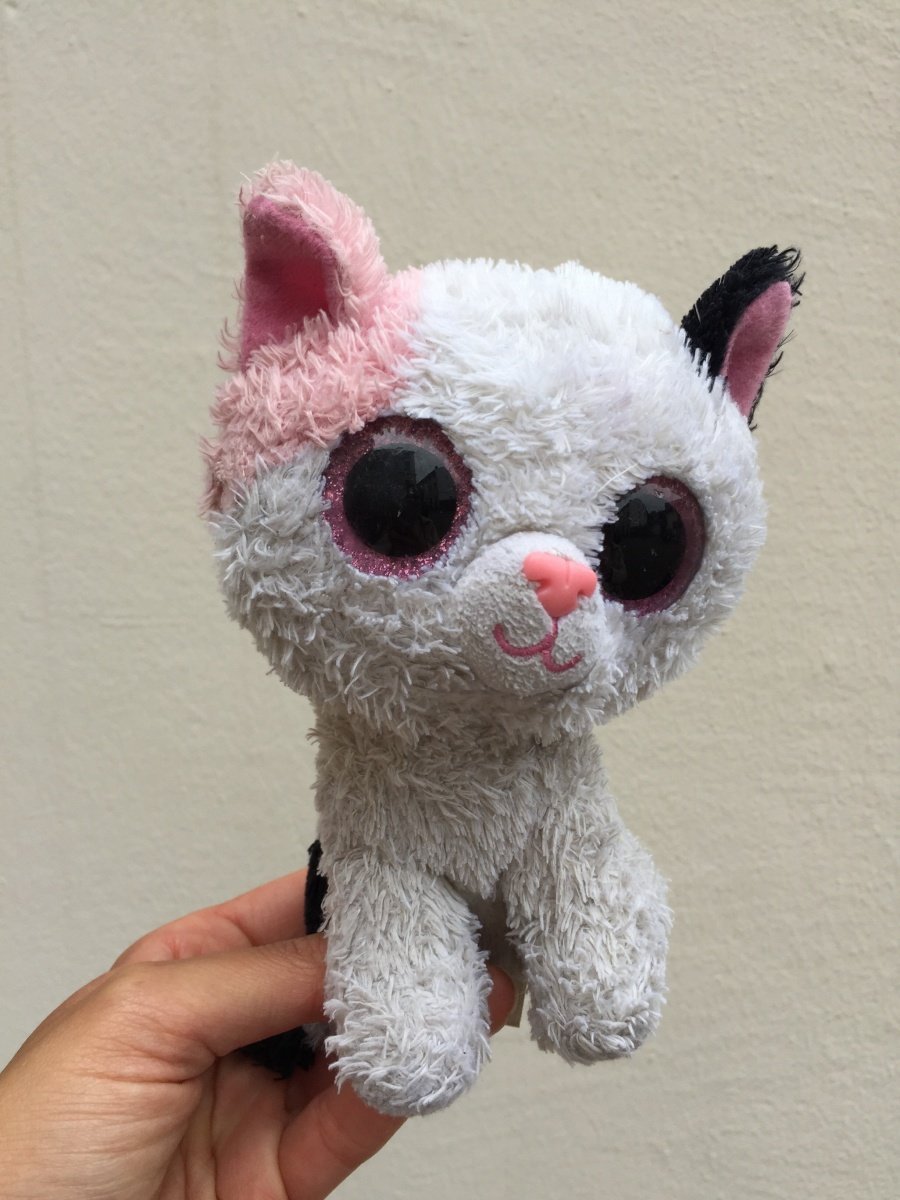
Do you have a ritual with the kids while you're away on business trips?
Yes, I always take “Muffin” along. That's our business-trip stuffed animal, a googly-eyed little guy. When I'm far away, like recently in San Francisco, I send photos of “Muffin” from my phone and tell the kids little stories to go with them. The girls send back smileys and voice messages. And of course “Muffin” is supposed to come along into space, too.
This interview originally appeared in Eltern Family magazine (issue 11/2017).
This story first appeared in German on StadtLandMama.