
Kids Who Don't Feel Like It: The Art of Doing It Anyway
Heads-up: This post contains affiliate links. If you buy something through them, we may earn a small commission at no extra cost to you. As an Amazon Associate, we earn from qualifying purchases.
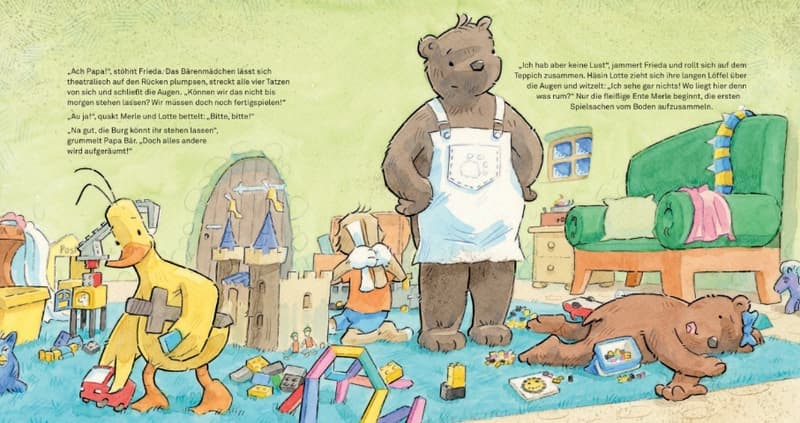
Frieda the bear flops on the floor: "Don't feel like it!" Papa Bear's answer isn't a threat or a bribe, and it might work at your house too.
Hi, friends! You probably know Stefanie Rietzler and Fabian Grolimund from www.mit-kindern-lernen.ch. They've written here before about picky eaters, about positive reinforcement for kids, and about dreamy kids. Now the learning coaches are back with Frieda hat keine Lust (that's German for "Frieda Doesn't Feel Like It"), a story about motivating kids who aren't exactly thrilled about brushing their teeth or taking out the trash…
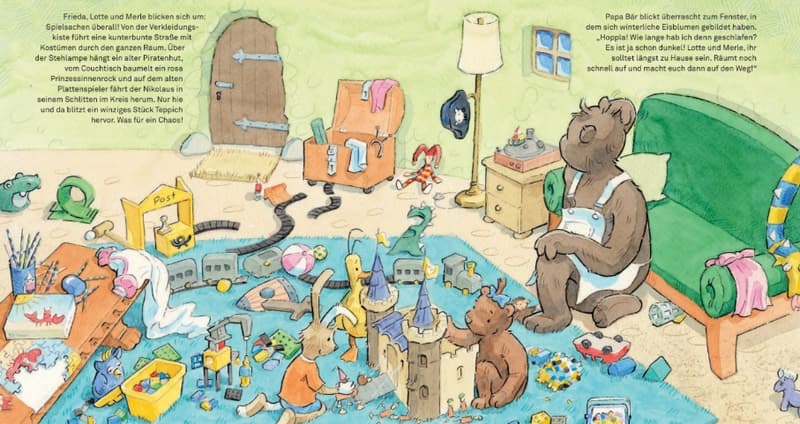
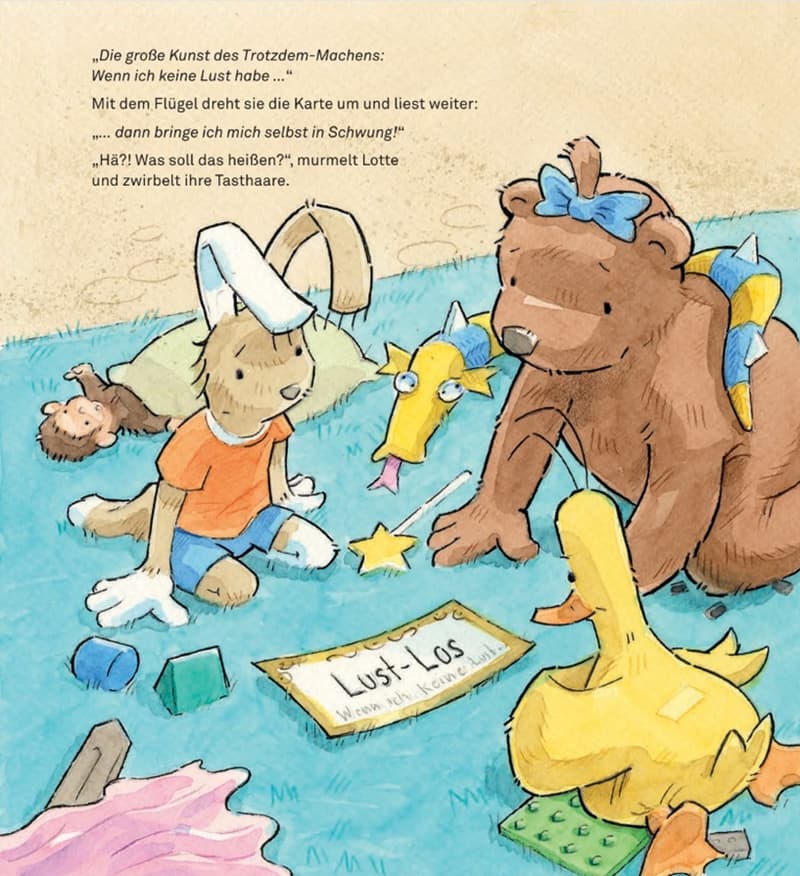
What's it about? Well, things are getting wild in the cozy bear den! Frieda the bear, Merle the duck, and Lotte the bunny are playing, laughing, and tumbling all over each other. The three of them leave a giant mess in the living room. When Papa Bear calls for cleanup, Frieda flops down, arms and legs splayed out: Don't feel like it!
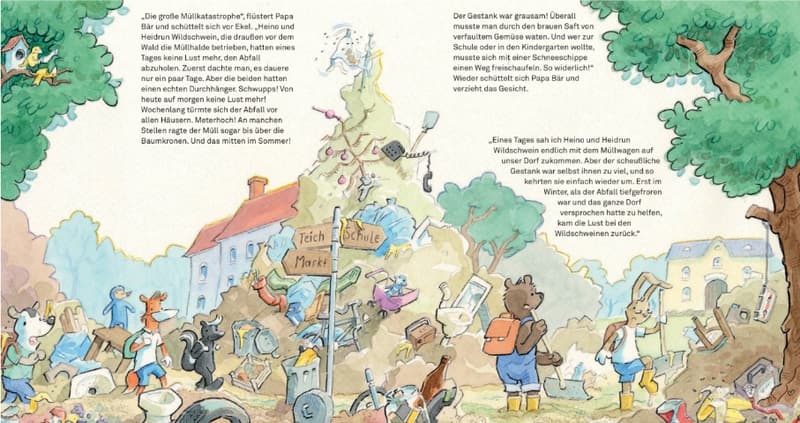
But instead of scolding, Papa Bear tells a story from his own childhood. Different times! Back then, everybody only did what they felt like doing. The result? Empty shelves at the bakery, stinking mountains of garbage all over the village, and even a house with no roof! Life only got easier again when the wisest animals discovered the great art of doing it anyway. With imagination, humor, and clever tricks, every animal in the village found a way to tackle the jobs they'd rather skip…
Brushing teeth, cleaning your room, getting dressed in the morning, finishing homework: kids don't enjoy any of it sometimes. In this warmhearted, funny picture book, kids between 4 and 8 can find a fitting "Lust-Los" for every situation. Think of them as don't-feel-like-it tickets: practical, everyday strategies for finding motivation, with no pressure and no finger-wagging.
Friends, what if I ask my child to clean up their room and they just don't feel like it?
The starting point is clear: your kid couldn't care less. And for exactly this situation, psychology and education have come up with a whole grab bag of methods.
Option A: Threaten and announce consequences. You plant yourself in front of your child, put on a stern face, and growl in your most serious voice: “Anything still lying around tonight goes in the trash / gets donated / gets eaten by the vacuum (insert your personal favorite threat here).” Then you have to follow through, no mercy. Thankfully, this approach has gone way out of style, because it unsettles kids and strains the relationship.
Option B: Rewards! A sticker for clearing the plate here, a point for the board game that finds its way back onto the shelf there. Rewards work better than punishments and do less harm to the parent-child relationship. For a long time they were promoted as the parenting tool for getting kids to show “desired behavior.”
But as a parent, you quickly turn into a bookkeeper who has to keep track of the kids' point tally and constantly come up with new rewards out of thin air. And suddenly your child's favorite comeback to every little request is: “Uh, but what do I get for it?” Plenty of parents also dislike how manipulative this method feels. We want to meet our kids at eye level, not train them like puppies.
Option C: Appeal and debate. “Do you think I enjoy everything I do?” “Nobody's going to pick up your stuff for you later, you know!” “Do you think I'm your maid?” With these and similar breezy lines, you appeal to your child's common sense. What you get back is, at best, an eye roll or a blank stare.
Option D: Give in. Following the motto “your room, your mess,” you leave the room and close the door. Now it's up to your child to fight a path through the toys to the bed. This does cut down on conflict, but it often leaves kids overwhelmed:
At some point it gets so chaotic that the child sees nothing but one giant mountain and has no idea how to get it under control. A friend of mine from childhood took this so far that he eventually had mice in his room, lured in by crumbs and food scraps nobody ever cleaned up.
Option E: Do it yourself. You clean up for your child, wait in vain for a thank-you, and then sit through a tirade because your kid supposedly can't find anything anymore. On the plus side, the room looks nice and tidy. Overall, though, pretty unsatisfying.
Option F: The Educational Fireworks Show. It has to be playful, it has to be fun, you have to spark the child's enthusiasm! So: put on music, stage a cleanup challenge, show up to work in a garbage-truck costume, hunt for everything blue first, then everything red, and let the supermoms on Insta “inspire” you with fresh ideas every day.
Sounds great. Can work. Wears off incredibly fast and leaves everyone frustrated. But maybe… the next new idea will do it?
Option G: Simplify. Lots of kids are simply overwhelmed by cleaning up. They get into play more easily, and it's also easier for them to keep track of things and tidy up, when their room isn't overflowing. So instead of elaborate organizing systems, rotate the toys and store the rest in the attic or basement.
One big drawer or bin you can toss everything into beats a bunch of shelves and containers that only look neat if your child fills them carefully and has a ton of discipline. For older kids, simplifying sometimes also means having a checklist handy that walks them through the cleanup (for example: 1. Dirty laundry in the hamper. 2. Plates and cups to the kitchen. 3. All the Lego pieces in the yellow box.).
Option H: Help. Following the motto “Come on, together we'll be done in no time!” you pull your child in, hoping to lower the hurdle and give some guidance. And then there's the Papa Bear method. You get your child's attention with an exciting story and, almost in passing, land on the topic of self-discipline. Does it help? Try it and see!
How did you come up with the idea for the picture book “Frieda Doesn't Feel Like It”?
One Saturday, my kids (this is Stefanie) had pulled out what felt like half their room to play with all their toys in the living room. Of course, at some point it was time to clean up. Unfortunately, there was zero motivation. And suddenly a question snuck into the room: What would happen if everyone in the world only did what they felt like doing?
And what if all the chores just got left undone? If the garbage truck stopped coming and we biked to our favorite bakery in the morning and found empty shelves? If the bus driver suddenly got out and went to have a coffee? The stories got more and more absurd, and the kids got more and more amused. Eventually we did tackle the mess after all. You don't always have to feel like it to push yourself to take on a task.
“Would other kids find this funny too? And would it help them sometimes just do something without waiting for the motivation to show up?” These questions soon turned into the idea for our children's book “Frieda Doesn't Feel Like It.”
How can we explain the art of doing it anyway to kids?
It's valuable to remind ourselves that pushing yourself is a skill we can build up bit by bit. A healthy dose of self-discipline helps in all kinds of areas of life. It helps us reach goals and supports us in taking care of ourselves, our health, and our surroundings.
Various studies show that this skill even plays an important role in relationships, because there we can't selfishly do our own thing all the time and, say, leave all the tedious tasks to the other person just because we don't feel like it. Still, long explanations or moral lectures often backfire. Kids get annoyed and feel lectured and talked down to.
That's why, in our story, it's not just the kids who struggle with motivation, but the adults too. In everyday life, it's often more helpful to connect with our child as well. Instead of asking, “Do you think I enjoy everything I do?” we could admit how hard it sometimes is for us to tackle this or that.
One evening after a long workday, I (this is Fabian) still had to give a talk over Zoom. I said to my daughter: “I'm so tired and I really don't want to give a talk right now. You're often so good at pushing yourself when you have to do your math homework, even though you hate it. Do you have any tips?”
She said: “Dad, it helps me to imagine that afterward I get to lie in bed and listen to an audio story.” I replied: “But the talk lasts two hours. That would only help me toward the end. Do you have another idea?” And she did. “Just imagine they're all nice people who are taking time out of their day to listen.”
And that actually motivated me!
When we work with groups of kids and teens, we sometimes ask: “What helps you study for the subject you hate most?”
At first the students are usually pretty surprised that adults admit there are “hated subjects” and that it's okay to have them. But a flip chart quickly fills up with all kinds of ideas.
It helps when kids and teens get to know themselves better, step by step, and are allowed to figure out how they tick and what helps them get past their inner roadblocks.
Our picture book “Frieda Doesn't Feel Like It” is meant to open the door to these kinds of conversations with younger kids between 4 and 8. Concrete ideas in the form of cut-out “Lust-Los” tickets invite kids to try out different strategies in daily life. And there's plenty in daily life that kids have to push themselves for: getting up early, brushing their teeth, getting dressed, walking to preschool or school, finishing homework, practicing an instrument, or, yes, getting their space in order.
How do you motivate yourselves these days for tasks you don't feel like doing?
We like to tackle tedious tasks together, following the motto “A trouble shared is a trouble halved.” Whenever possible, we create a nice atmosphere for it: a cozy café, a piece of cake, a little chat first, and then it's on to grading or annoying emails.
Often, alternating between enjoyable and exhausting tasks helps keep our energy up. And finally, sometimes a little complaining time does us good, ten minutes of moaning to each other about how badly off we are and how much we hate this or that task, so that we can then do it anyway with heroic courage.
Stefanie Rietzler and Fabian Grolimund are psychologists who run the Academy for Learning Coaching in Zurich together. They've written several bestsellers together, including “Erfolgreich lernen mit ADHS und ADS” (“Learning Successfully with ADHD and ADD”) and the children's novel “Lotte, träumst du schon wieder?” (“Lotte, Are You Daydreaming Again?”). More about their work: www.mit-kindern-lernen.ch
This story first appeared in German on StadtLandMama.