Picky Eaters: Why Pressure Backfires and What Actually Helps
Heads-up: This post contains affiliate links. If you buy something through them, we may earn a small commission at no extra cost to you. As an Amazon Associate, we earn from qualifying purchases.
He lost six and a half pounds on a ski trip and still wouldn't touch lunch. Why hunger and pressure don't work, and what does.
Hi friends! We're big fans of Stefanie Rietzler and Fabian Grolimund, the psychologist-author duo whose work helps kids feel happy and secure in their relationships. Now they've written another wonderful book on an incredibly important topic: picky eaters.
It's called “Willst du nicht wenigstens mal probieren?” (“Won't You at Least Try It?”), and it's about picky eating, meaning kids (roughly ages 3 to 8) who suddenly want nothing but buttered noodles or nothing but french fries. How do we handle that lovingly, without piling on pressure? Here's what they told us.
Okay, you two, what do I do if my kid wants nothing but plain noodles for a while, and absolutely no vitamins?
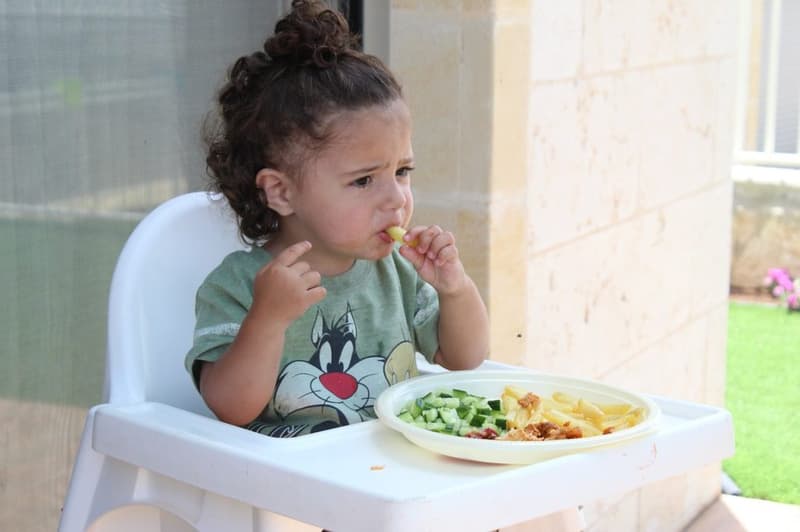
Stefanie: Start by looking at what developmental stage your child is in. It's completely normal, and probably evolutionary, for kids to be fairly adventurous eaters when they're first starting solids and then for their range of tastes to narrow. For some kids that happens more, for others less. Once children can explore the world on their own two feet, it gets dangerous fast if they put every kind of green thing in their mouths, since out in nature those are mostly poisonous. Better to stick with sweet and fatty foods, which for thousands of years were great sources of energy and kept us alive!
So nature has given kids a sensible protective mechanism. One study backs this up: it showed that in toddlers, the bitter taste receptors on the tongue increase in number. That makes them more sensitive, and therefore pickier, about a lot of vegetables. Only in the preschool and elementary school years does the menu slowly widen again. This is completely normal at first and no reason to worry. With that in the back of your mind, you can simply lean back during this phase and hope for better times.
Fabian, I can tell you want to add something…
Fabian: Some kids are really picky, though, and stay that way. I'm speaking from my own experience as a dad… In that case, there are a few things we can watch for in everyday life. One of the biggest traps, and I've stepped right into it with my own kids: at some point you only cook the four or five dishes your little food skeptic will definitely eat. Unfortunately, that makes the problem worse!
Research shows that two of the most important factors in dealing with picky eating are repetition and learning by watching others. A picky kid needs to come into contact with a food 8 to 15 times within a short period before the first hesitations start to fade and they're even willing to try it. And every time they see parents, siblings, or friends enjoying an unfamiliar dish, they get the signal: “This food is safe and totally fine to eat!”
But if we cook nothing except our handful of standard dishes because otherwise the kid just wrinkles their nose, their range won't expand. As a parent, you quickly land in a dilemma: you want to spare yourself the effort of cooking something your child will probably reject, but at the same time you're helping make sure they'll only want the same three or four things in the long run…
Stefanie: Picky eaters are usually very sensitive to certain textures, smells, and flavors. It can pay off to look closer: which qualities does my child like? And can I use that familiar food to build a bridge to something new? A family who signed up as test readers for the book had an aha moment like that: their son loved anything crunchy and fried, and fish sticks in particular.
So they ventured to make veggie sticks in the same shape with the same breading, and they could tell their son, “Look, it's just like fish sticks, only with a different filling.” And, surprisingly, he tried it! Another dad told us his daughter is crazy about waffles of all kinds, so he was able to sneak finely grated zucchini and carrots into a savory waffle batter, and she accepted it. It's not always like that, of course, but the perspective is still helpful: where can I connect to something familiar?
You've now written a book about picky eaters. How did you come up with the idea?
Fabian: The idea for this book came about differently than usual: totally spontaneously, on a whim. We were working together one day, shortly before lunch, and I was once again complaining to Steffi that I've been cooking the same five dishes for years because my son is so picky: “If I cook something else, he just fries himself some eggs and eats them with a piece of bread. It drives me crazy!”
Stefanie: My oldest had just come down with hand, foot, and mouth disease and could barely eat because of the pain. Getting anything into my kid was a real battle. They were constantly hungry, in a bad mood all day because of it, and had one meltdown after another. And I thought, “How exhausting must it be if it's always like this!”
Fabian: And there it was, the idea: we need a children's book on this topic! For us, for our kids, and for all the other families in the same boat.
The kids' book serves up steaming wild boar dung, fresh-caught jellyfish goo, stringy water plants, and slippery-soft snail slime. I'm wrinkling my nose just reading it… were those your kids' ideas?
Fabian: No. We wanted to surprise them with the book! We just had a feeling that the best medicine against all this stress around healthy eating and being made to try things is a big helping of humor and laughing together. Our kids often think gross stuff in books is hilarious, so it made sense to look to the animal kingdom. They serve up all kinds of disgusting feasts there …
Stefanie: My favorite picture book as a kid was written in rhyme. And I still love reading poems today. It was clear to me that if we were really going to write a book for picky eaters, it had to come with sassy rhymes.
Fabian: Honestly, at first I had to push myself to rhyme. Steffi had to talk me into it. But as soon as the first verse was done, I got caught up in the excitement, too:

In some families, I notice how much the kids' eating gets commented on. “That's healthy.” “Don't take so much of that.” “Just one more pea.” What do you think is the right mix of staying out of it and giving guidance?
Stefanie: We dug into questions like these in depth while researching the book. We went through the scientific research on picky eating and checked which strategies have held up in research and in practice for helping picky kids widen their range of tastes.
We found the results so interesting and helpful that we added a section for parents to the picture book that sums up the most important background and tips. And you can probably guess: constantly pointing out what's healthy or unhealthy, commenting on how your child eats, and using force is anything but helpful.
Fabian: Personally, though, I still find it hard to hold back on comments. As a parent, you feel guilty, and you get a little scared for your child's health when they turn down every vegetable and would happily eat nothing but sweets and frozen stuff all day. Before you know it, lines slip out like “Do you always have to eat that junk?” or “Come on, at least something with vitamins …”
I had a real aha moment when my son went on a school ski trip. Beforehand, my brother-in-law told me: “The minute your son comes off the slopes hungry and his whole class is eating whatever's put on their plates, he'll change how he eats. Hunger will do the trick.” Nope. Our son came back having lost about six and a half pounds! At breakfast he could still count on his rolls with jam. But neither hunger nor the dumb remarks from his classmates could get him to touch lunch or dinner.
These days I try to remind myself that a relaxed, positive mood at the table is one of the most important things that, in the long run, helps picky eaters eat a wider variety. But that's real work on myself, and it doesn't come easily.
So staying out of it completely doesn't work?
Stefanie: Staying out of it completely doesn't work, and constant commenting backfires, too. So what then? When it comes to picky eating in kids, we found the so-called division of responsibility very helpful. It has calmed things down for a lot of families. With it, the parents set the framework: when and where food is eaten and which dish they cook.
The child decides whether to eat, what to eat, and how much. So, for example, I've pan-fried a fish and made a little veggie on the side, and now I make sure there's always at least one “safe food” on the table that my picky kid can usually eat without fuss. Maybe rice or noodles. It's best to put the components on the table separately.
Important: I now let my child serve themselves. If they're still too little to dish up on their own, I can ask: “Would you like some rice? This much..? Sauce, too? Right on top or on the side?” Many picky eaters hate it when their food gets mixed together. A mom told me recently: “When my extremely picky eight-year-old eats with us, the foods can't touch. So I bought a few plates with divided sections. Our son still eats everything one after another, section by section, but he tries quite a bit more than before and he's fuller, too.”
Fabian: Important: I don't comment on whether or what my child puts on their plate. And yes, they might only ever dish up plain noodles or rice and not even finish that, but as I said, the research shows very clearly that repetition is a key factor. That means: if our picky eaters keep seeing foods on the table and watching others enjoy them, they can gradually lower their own hesitation and resistance. With every round, they get a little more used to the sight and smell. All of that demonstrably makes it more likely that at some point they'll try it themselves.
Sometimes timing matters, too: my son rarely eats fruit and doesn't eat vegetables at all. But if he comes home from school hungry, I'm still cooking, and there are already a few apple slices on the table, I sometimes get lucky…
When I was preschool age, we moved, and I ended up in a new daycare where I was forced to try everything at lunch. We weren't allowed to drink anything during the meal, only a cup of tea afterward. To this day I have a tea trauma (and it's not even the tea's fault)…
Stefanie: You're not alone in that experience. There are even studies showing that people who were forced as kids to eat certain foods against their will often develop a strong disgust and a lifelong aversion to them. Sadly, many parents of picky kids have told us that professionals are still advising them to use pressure. You hear advice like: “Then only healthy food goes on the table. Nobody ever starved in front of a full plate,” or “If you don't eat your vegetables, you don't get dessert.” But pressuring kids to constantly try things demonstrably increases their fear of new foods and their resistance.
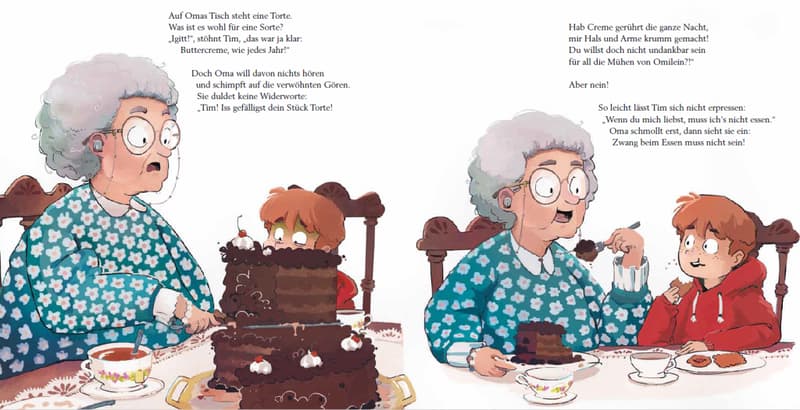
How do we actually create a relaxed atmosphere at family meals?
Fabian: By making that our top goal! And by trusting our child more, trusting that their body will get what it needs in the long run. It helps to know that deficiencies are fairly rare even in picky eaters and, when they do occur, can usually be eased well with supplements. That takes a lot of pressure off me as a parent. And the division of responsibility we described earlier is a big relief here, too.
Stefanie: Eating in a relaxed way can also mean letting go of certain ideas: that you have to clean your plate. That eating vegetables doesn't need to be, and shouldn't be, the price of dessert. That it's part of natural exploration with all the senses when little kids smear food around and play with it, even if that annoys or grosses out us grown-ups. This playful, curious approach has also been shown to break down resistance to new foods. And that it's absolutely okay for kids to get up from the table and go play once they feel full.
Are there ways to encourage our little picky eaters to widen their range of tastes, in small, careful steps toward trying something new, lovingly and without pressure?
Fabian: We've already covered quite a bit: eating together as a family, and keeping the atmosphere as relaxed as possible, with no critical comments, rewards, or pressure to try things, is really important. So we should happily say goodbye to the title line of our book, “Won't you at least try it?” (the rhymes resolve that with humor as the story goes on). Being able to see certain foods again and again in a short time, and watching others eat a wide variety, helps, too.
Building bridges to familiar dishes by tweaking what they already know can help. Inviting your child to cook with you and involving them in meal prep in general has also been shown to reduce picky eating. Here, too, it's important not to force it and to accept it if your child doesn't feel like it. And finally: have patience.
Progress comes in small steps. You have to think in months and years rather than whether your picky kid tries something new today or tomorrow. And if they do, for once, pop a tiny piece of cucumber in their mouth: stay calm. No gushing “Great, so you did try it after all!” and no “See, it doesn't taste so bad, does it?” That usually spoils it for picky kids right away. Better to quietly enjoy the moment ;-).
You say picky eating is more common in neurodivergent kids (ADHD, autism spectrum). Why is that, and do we need to think differently about how we handle it?
Stefanie: Yes, there are several studies on this. They show that in neurodivergent people, picky eating has a lot to do with a lack of cognitive flexibility. In other words: if you already have trouble in daily life adjusting to the unfamiliar and the unexpected, and you find changes of plan very stressful, you're also more likely to look for routine and safety in familiar foods.
On top of that, people on the autism spectrum, and sometimes people with ADHD, too, have a greater sensory sensitivity: they pick up certain smells, flavors, or textures very strongly, and sometimes find them almost unbearable. The starting points are the same as described above, even though picky eating in these kids is usually more stubborn… Many of the tips in the book come from working with neurodivergent kids!
Fabian: There were some really lovely moments in this context, too. More than half of the test-reader families who gave us feedback on “Won't You at Least Try It?” live with at least one neurodivergent child. And, inspired by the book, some of them had really interesting and funny conversations. One boy with autism spectrum disorder, for example, absolutely wanted to read the guide section for parents at the end of the book.
Among other things, he learned that picky eaters need to come into contact with a new food 8 to 15 times before they'll even want to touch it. His mom wrote to us that her son tried pineapple for the first time that very evening. As so often, it had a few sweet pieces and a few sour ones, and the boy looked at his mom with a sour-scrunched, grinning face and said proudly, “I've already eaten 5 pieces, so it'll take at least 3 more until I like it…”

Dear Steffi, one last personal question: you're technically still on maternity leave! How are you and the sweet little newcomer doing?
There's a lot of love, gratitude, delight, and wonder, mixed with sleep deprivation, nursing brain, chaos, the never-ending ping-pong of viruses and germs, and of course being kept on my toes in daily life with a baby and a toddler. I think we've found our groove as a family of four. It certainly helped that my husband took four weeks of unpaid leave after the birth.
That way I could recover physically during the postpartum weeks, and we got to be there for both kids together from the start and shape our new daily life as a team. I love being a mom. And I'm grateful that I can fit my work together with my family. For example, we wrote “Won't You at Least Try It?” with Fabian sitting at home in front of his laptop while I walked around with the baby asleep in the carrier, writing rhymes with Fabian over Zoom. You should have seen the looks from people passing by …
This story first appeared in German on StadtLandMama.