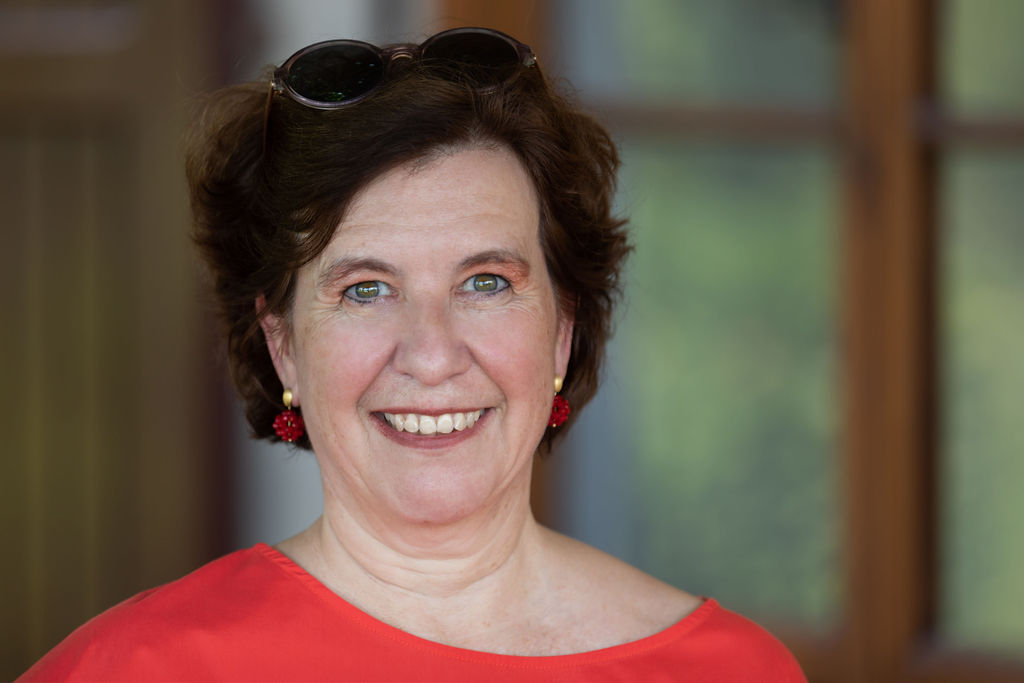
Dear readers, Dr Ute Taschner is a doctor, mother of four children and expert in supporting women after difficult or traumatic births. She has been working in medicine for over twenty years, including in obstetrics, and has accompanied many women on their journey after a stressful birth. Here she talks about her friend Franzi, who developed an invisible trauma after giving birth.
„My friend Franzi was perfectly prepared. She was a fitness trainer specialising in pelvic floor exercises and pre- and postnatal training, was in excellent health, had a balanced diet, had had a flawless pregnancy – and had also practised hypnobirthing and meditation. She was ready for the birth of her son. Everything should have gone smoothly. After an unremarkable CTG examination at the hospital, where Franzi had gone because she was feeling the first contractions, the doctor asked Franzi if she had already lost her amniotic fluid. At that very moment, she felt a warm sensation between her legs. Franzi was overjoyed – here we go! But it wasn’t amniotic fluid. It was blood. A lot of blood.
Franzi later told me: „At that moment, I knew I had to put all responsibility for my life and my child’s life in someone else’s hands. I had to put my complete trust in the doctors and the team.“ Within seconds, her baby’s heart rate dropped from 130 to 80. The doctor looked at her and said: „Mrs K., we’re going to deliver your baby. NOW.“
What followed was an emergency caesarean section. Franzi’s son was born healthy. Biologically, everything was fine. But psychologically, a new chapter in Franzi’s life began, one she had not expected to be so intense…
Invisible trauma after childbirth
Unfortunately, I know many stories like this from my many years of working with mothers, because according to international studies, at least 20% of all mothers experience the birth of their child as traumatic.
If you have experienced something similar to Franzi, you now know: You are not alone with your story! Many mothers experience childbirth as an event that deeply shakes them. Whether it’s a caesarean section or a natural birth – whether everything „went well“ medically. Because: It does matter how you experienced your birth. It matters how you felt during it. It matters whether you were hurt or ignored. Birth trauma does not arise because you were too weak or because you should „stop making such a fuss“. Birth trauma is a normal reaction of your body and soul to an abnormal event. It occurs when an event violates our protective layer and leaves us feeling overwhelmed and helpless. When, according to Peter Levine, it was „too much, too fast, too sudden“. More than a year after the birth of her son, Franzi is still struggling. There are moments when she is overcome with tears when she thinks back to the birth. To this day, she cannot touch her caesarean scar – her body stored the memory of that day in every fibre. Recognising the signs of birth trauma
You may recognise yourself in some of the following symptoms: You are struggling with new panic attacks. You sleep poorly or not at all. Your heart races for no reason. You react aggressively more quickly. You feel paralysed or have the urge to withdraw. You cry more often, especially when you think about the birth. You don’t dare to be alone with your baby? You feel like a well-oiled machine, but your feelings have somehow disappeared? Or you are overwhelmed by very vivid memories – so-called flashbacks – and suddenly experience the birth or parts of it again as if it were happening now?
These symptoms are signs that your nervous system is still in shock. The good news is that help is available. There are ways to get out of this state.
What you can do yourself
You don’t have to wait for everything to get better on its own. There are concrete steps you can take to help yourself:
Talk about it. Yes, it hurts. Yes, you may be afraid of not being understood or of hearing, „The main thing is that the baby is healthy!“ But your feelings are just as important as your child’s health. Find people who will listen to you without judging you.
Write down your story. Note down the details – not just the medical facts, but how you felt, what you missed, who supported you well. Writing this down can be incredibly healing.
Take time for real postnatal recovery. Having a baby is a physical feat. Let yourself be mothered. The better you are cared for, the better your emotional and physical wounds can heal.
If you need more help
If the symptoms persist weeks later, if flashbacks dominate your everyday life, or if you simply cannot get out of this hole on your own, then professional help is not only sensible, but necessary. This has nothing to do with weakness; it is a necessary act of self-care.
There are various forms of therapy that are particularly effective for birth trauma: EMDR, Somatic Experiencing, Cognitive Behavioural Therapy. It is important that you find a professional you trust and who understands that birth experiences can be traumatic. (If you like, take a look at my website, where I offer this online course, for example: „Processing a difficult birth step by step„)
You are not alone
The memories of your birth will not simply disappear. They are part of your history. But they can fade. Emotional wounds can heal, even if physical scars remain.
Franzi still can’t touch her caesarean scar. She’s giving herself time. She talks about what happened. Healing is not a linear process. Healing is sometimes one step forward, two steps back, and starting over again and again. But it is progressing.
The most important thing I want to tell you is this: you are not alone in what you have been through. You are not too sensitive. You are not „making a fuss“. You are not ungrateful just because you have a healthy baby and still have tears in your eyes when you think about the birth.