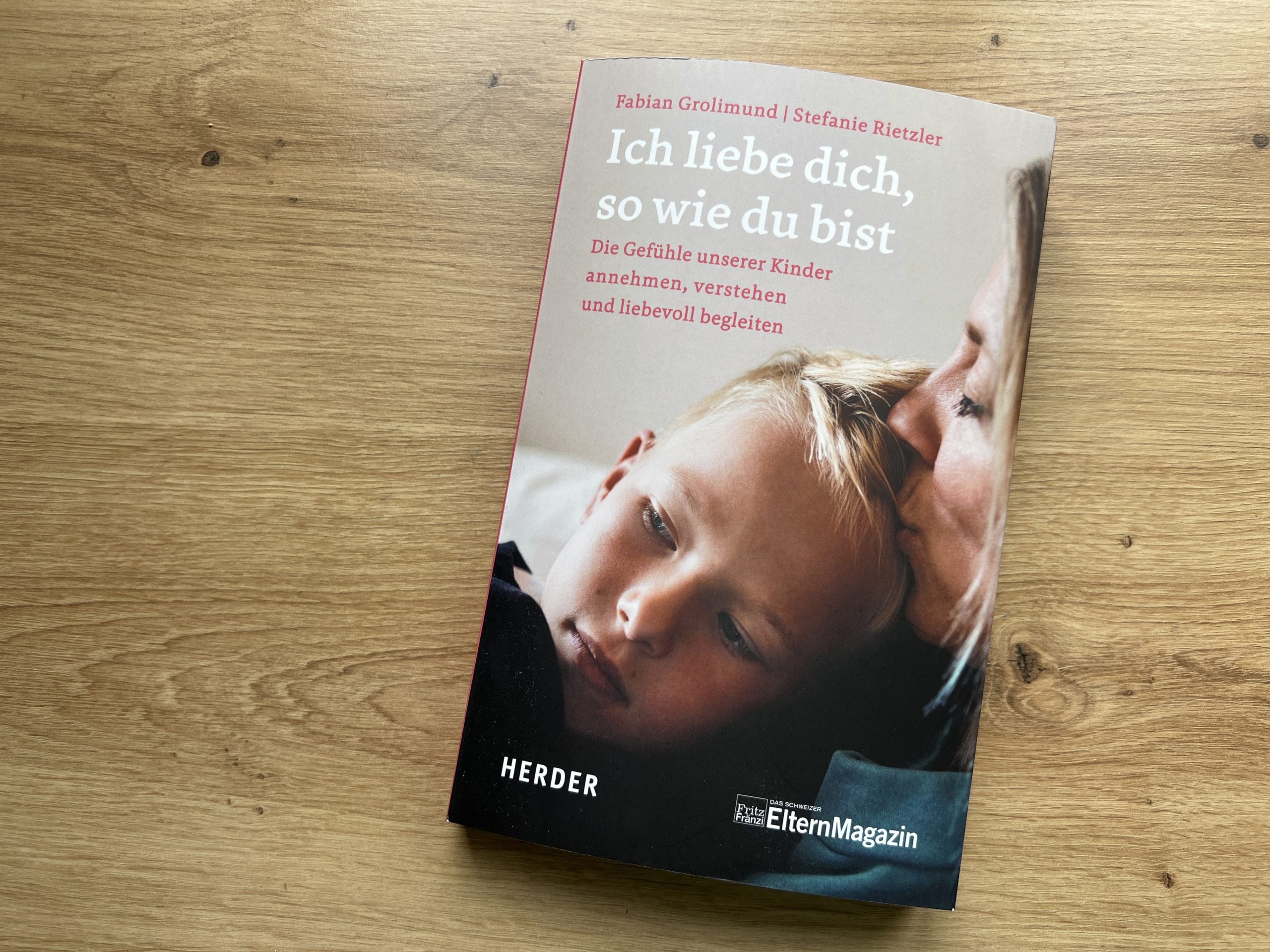
Dear ones, there are authors who make you want to soak up every word. Fabian Grolimund is one such author (if you want to read his book Erfolgreich lernen mit ADHS und ADS not yet have… please take a look, also for non-affected people simply eye-opening). Now, together with Stefanie Rietzler, he has written a new book, Quintessenz: Kinder positiv bestärken. Es heißt: I love you just as you are: Accepting, understanding and lovingly accompanying the feelings of our children. We asked the two of them for an interview.
Dear Fabian, dear Stefanie, „as parents, we can learn to remain empathetic while maintaining our boundaries, saying no and being authentic“, you write in your book. Could you give us a concrete example of how this can be achieved?
Many parents today would like to respond to their children’s needs and live out values such as equality in their relationship with their child. But if we weren’t able to experience this kind of interaction in our own childhood, we find it difficult to put it into practice. We quickly confuse empathy with being nice all the time and hope that our child will co-operate if we explain everything well and always stay calm.
And when the child throws a tantrum anyway, refuses to brush their teeth or keeps putting off their homework, we react with frustration and helplessness, suddenly get loud and scold them – and feel terrible afterwards because we have violated our values. This makes us parents seem unpredictable to our children: one minute mum or dad was whispering sweetly, asking if I could please hurry up a bit – and now I’m suddenly being shouted at!
And how do we get out of it?
Being authentic means that we as parents learn to pay more attention to our own feelings and needs and realise early enough when things are getting too much for us. We can also address this, ideally by staying true to ourselves and talking about ourselves.
Have you got an example for us?
For example, we have recommended the following to many parents where the homework situation regularly escalates: Pay attention to your feelings when you’re with your child when they’re studying. As soon as you start to get annoyed, say: „I realise I’m just starting to get annoyed. I don’t want us to argue about homework. I need a break now. When we’ve both calmed down, we’ll carry on.“
It’s amazing how many families have eased the situation because the children took more responsibility for the homework and said on their own initiative after a few minutes: „Now we can get on with it“. If we communicate our feelings openly, our children can better assess what their behaviour triggers in others and also react to it.
In counselling sessions with families, we have often noticed that children in particular who are often criticised and scolded a lot switch off over time. They simply tune out the nagging and scolding parents and teachers. If we make it clear how we feel and what we need instead of simply telling the child what they should or shouldn’t do, we can reconnect with them – and are also more likely to be taken seriously as parents.You say that „unconditional parental love“ is often misunderstood and misinterpreted as laissez-faire. In what way?
Yes. Some parents misunderstand unconditional love to mean that you accept or approve of everything the child does – that there are no more boundaries or rules. But that cannot and must not be our goal. Instead, we try to accept our child even in difficult situations by remaining attentive. We stay connected with our child and want to find out with them why they have lied or stolen, for example.
For example: A nine-year-old child was caught stealing a superhero figure in a supermarket. The parent could now scold the child and punish him by grounding him to show him that he must never do this again. But this boy’s mum reacted differently: she sat her son on the bed and said: „You know that stealing is wrong and forbidden. I want to know why you did it anyway.“The son tearfully explained that it had been a test of courage between boys and that he had got involved because he finally wanted some friends. The mum could understand this very well, as her son had hardly made any friends and was suffering greatly as a result. The two of them were able to talk about how important it is for their son to make friends – and that others sometimes take advantage of this. Together, they thought about how their son could make amends for what he had done and how he could react the next time others put pressure on him.
So we should stay in communication?
If we only punish a child, we learn nothing about their motives. We then simply hope that the fear of punishment will be enough to make the child act differently in future. But perhaps the peer pressure is stronger and the child is simply becoming more skilful at concealing such actions? In any case, it doesn’t have the feeling that it can come to us in an emergency.
To be very clear: it’s not about taking away the child’s feelings of guilt or lightly excusing their actions. It’s important that we show them: Yes, you feel guilty because you have done something wrong. But you can make up for it and I am by your side to help you. And the next time you find yourself in such a dilemma, you can come to me and find a sympathetic ear.
Families can get into trouble and things can get really heated at times. How can we guide our children well through their anger?
In order for children to learn to deal with their anger constructively, they need carers who empathise with them, who can help them deal with this emotion and find ways to calm down. However, this is incredibly difficult for most parents and we won’t always succeed. It’s far too easy to get carried away by the children’s emotional storms, become loud or flippant yourself or simply feel overwhelmed by the situation because you can’t „calm“ the child down.
On the one hand, this is due to the fact that the energy tanks of many parents are chronically empty these days due to the many demands of family, household and work and they often lack the strength to remain calm and attentive in heated situations.
On the other hand, very few people have learnt how to deal with anger in a healthy way during their own childhood! In the past, our current generation of parents often experienced that anger had to be suppressed: „That’s enough! Stop this theatre! You go to your room now until you come to your senses! That’s no reason to get angry right away! Are you still a little baby, acting like this?“
This imprinting makes it difficult for us to put up with our own children’s defiance, anger and annoyance. After all, we would never have dared to show ourselves like this in the past! In addition, most people lack good role models: perhaps they experienced their own father as choleric and therefore associate anger with threat. In this case, the old feelings of panic or powerlessness suddenly resurface when your own child snaps.
Or you had a mum who bottled up any frustration and punished you by withdrawing love instead of openly communicating what was bothering her. Then you learnt that you have to appease and satisfy loved ones as quickly as possible so as not to lose their affection. Your child’s anger can reactivate this pattern. However, if we want children to be able to endure their anger and deal with the feeling in the long term so that they don’t harm themselves or others, then we ourselves must learn to endure and hold on to this emotion.
Your book even contains a declaration of love for anger…
Yes – because anger is wrongly seen as a frowned upon and negative emotion. The problem with anger is not the feeling itself, but when it is expressed destructively: In aggression against others or against oneself. However, anger is an important signal from our psyche and essential for our well-being. It indicates when our own needs are being ignored and boundaries violated, when someone wants to harm us or prevent us from achieving an important goal. It activates us and drives us to change!
However, those who have had to learn to suppress this feeling fall by the wayside: at some point they no longer know what they want or need, remain stuck in toxic love relationships or work environments for too long, don’t dare to say no and stand up for themselves, are more susceptible to many illnesses and even die earlier on average.
Children who have been „trained“ to express their anger by being deprived of love, for example, often appear very nice, well-adjusted and well-behaved on the outside. The price the children have to pay for this only becomes clear later. Many adults need psychotherapy in order to get back in touch with their own feelings and take themselves and their needs seriously.
How do we, as parents, manage not to get loud or snotty when we feel helpless and hurt? To put it provocatively: isn’t it even authentic to be angry sometimes?If we allow our children to be angry, we can also allow ourselves to be angry. Then the same applies to everyone in the family: We want to learn to express this feeling in a way that doesn’t harm others. Children should learn not to hit or bite, parents should learn not to intimidate their children and to refrain from shouting or hitting.
What if my parents didn’t guide me well through periods of anger? How can I break through patterns and learn to deal with them better with my own children?In our book, we present various ways to better regulate ourselves: Firstly, we ask ourselves how we can take better care of ourselves and our needs in everyday life so that we don’t constantly slip into the red zone. Above all, however, we focus on our own feelings and imprints. For example, we can take a closer look at a situation in which we became angry: What exactly happened? What did I feel? What was going through my head?
You may notice that certain thoughts keep popping up: „My child has no respect for me and doesn’t listen at all!“, „You can’t put up with this!“, „My children are so ungrateful…“, „I’m sacrificing myself here and this is the thanks I get?!“, „Is she doing this on purpose?!“. We can put such thoughts through their paces and often realise that they do not correspond to reality. If we manage to build up new convictions and look at situations from a different perspective, we can remain more relaxed.
How can we do this during a public tantrum, for example?

When a two-year-old child throws himself on the floor in the shopping centre because he really wants something, we get angry thinking: „He always does that! So embarrassing! Everyone is staring at us! Why can’t he ever pull himself together? I can’t let him win!“. But we could also realise that it’s completely normal for a child of this age to want something so badly. And that they are not yet able to postpone their wishes by saying to themselves: „Maybe I’ll get the sweet next week, I can wait until then.“
We could say to ourselves: „I’m allowed to say no – and my child is allowed to be angry. That’s completely normal. Other parents experience this too – and if someone has to look stupid because of it, then let them do it – my child is more important now than some stranger.“ We can then simply take the crying child in our arms and comfort them if they allow it.
You want to give children positive reinforcement, advocate constructive interaction with them and give very specific tips, for example when one child pushes another. Then we often say: „Hey, it’s not being pushed“, but a „Tell your neighbouring child ‚Give me space'“ would be much more sustainable and effective because it shows alternatives… what other tips do you have?
Most adults think it’s important to show children and young people the consequences of their behaviour. Unfortunately, they often only focus on the negative. Children learn much faster if we point out positive models and connections. For example, we could say:
- Have you noticed how happy Lisa was when you shared with her?
- I saw earlier that you asked Benni if he wanted to play with you. He seemed quite relieved – I don’t think he was afraid to ask you.
- The (Nintendo) game comes out in five months? Why don’t you work out whether you can buy it if you save your pocket money until then.
- Thank you for putting the money away. If you put it back in the cups after playing, it won’t dry out.
Studies have shown, for example, that pupils were less motivated and rated learning as less meaningful if their teachers often pointed out negative consequences such as: „If you don’t make an effort now, you won’t make it through the year!“ or „With a bad report card like that, you’ll have a hard time finding an apprenticeship“.
They were more motivated, on the other hand, when the same context was presented in a positive light: „I think if you prepare well for the last exams this semester, you could manage to get a good enough average“ or „Every half mark you improve now will help you find an apprenticeship“. On a purely factual level, both may mean the same thing: However, we perceive the former as a threat, whereas in the latter case we have the feeling that the other person is interested in us, has confidence in us and wants to support us. We present many other possibilities in the book.
Studies have shown, for example, that pupils were less motivated and rated learning as less meaningful if their teachers often pointed out negative consequences such as: „If you don’t make an effort now, you won’t make it through the year!“ or „With a bad report card like that, you’ll have a hard time finding an apprenticeship“.
They were more motivated, on the other hand, when the same context was presented in a positive light: „I think if you prepare well for the last exams this semester, you could manage to get a good enough average“ or „Every half mark you improve now will help you find an apprenticeship“. On a purely factual level, both may mean the same thing: However, we perceive the former as a threat, whereas in the latter case we have the feeling that the other person is interested in us, has confidence in us and wants to support us. We present many other possibilities in the book.