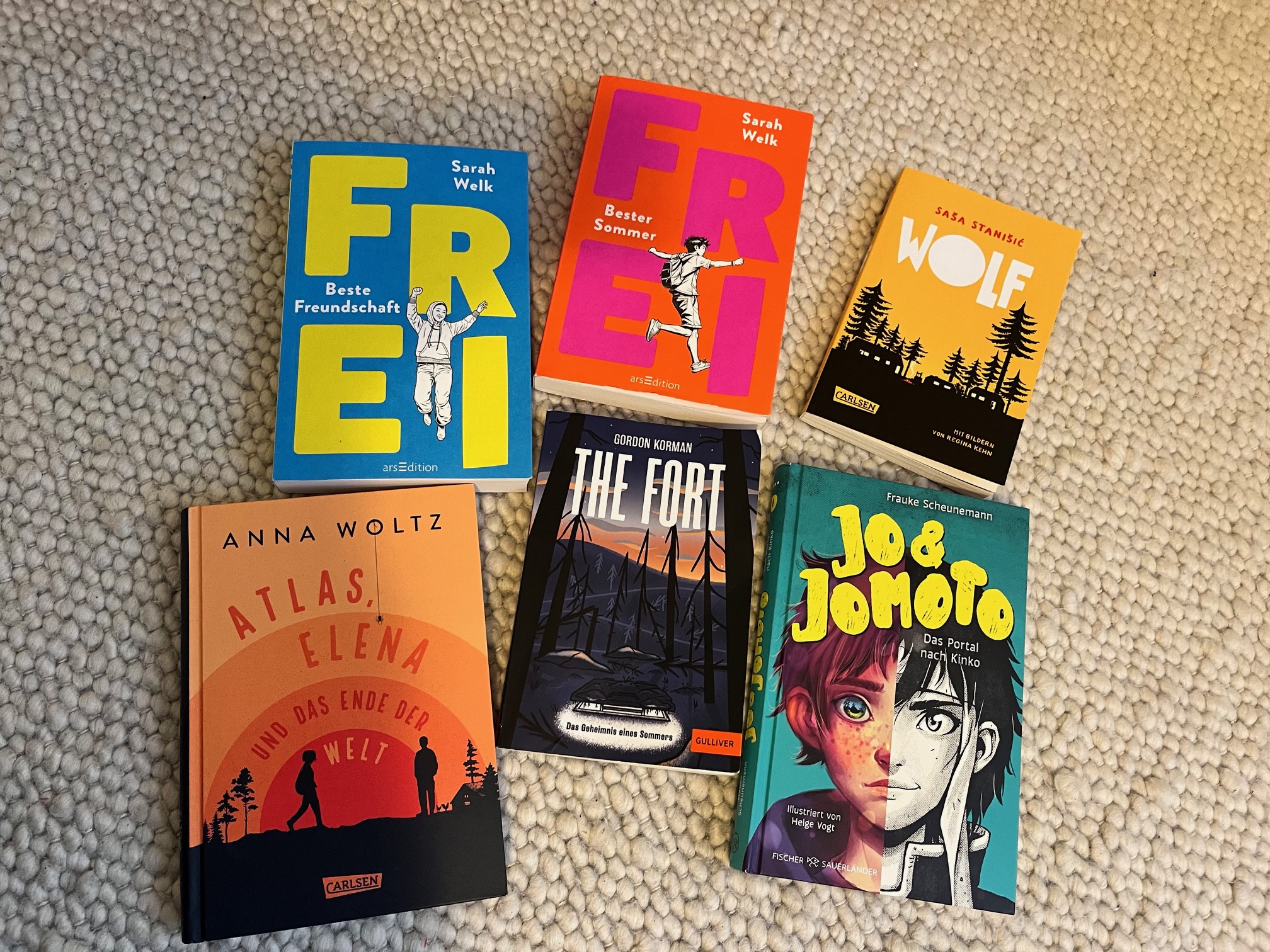
Dear readers, you may remember family coach and media expert Petra Trautwein from her article „Raus aus dem Schulchaos“ (Out of the school chaos). At that time, stress about grades was still her main topic. Today, she considers the media to be the biggest challenge for parents, and that is precisely what her new book „Handyfrei – so bringen Eltern ihren Kindern den vernünftigen Umgang mit Handy & Medien bei“ (Mobile-free – how parents can teach their children to use mobile phones and media sensibly) is all about.

Petra Trautwein says: „The number one cause of problems at school is digital media.“ She believes it is the biggest challenge in education today. Psychologists now agree with her. And not just sometimes, or for some children, but across the board. When children spend several hours a day in front of a screen – whether playing games, watching YouTube or using social media – their brains are permanently flooded with stimuli. ADHD, concentration problems, learning difficulties, lack of exercise and tantrums are signs of sensory overload, she says.
Dear Petra Trautwein, you say that dealing with media is the biggest parental challenge of our time. Tell us why.
When I work with parents, I see the same pain everywhere: we feel that mobile phones take up too much space in everyday family life and don’t know what to do about it. Not because we are bad parents, but because digital media have been developed in such a way that even adults with their mature brains can hardly resist them.
What we absolutely must understand in this context is that our children do not yet have the internal filter that reliably distinguishes between what is important and what is unimportant, nor do they have a mature prefrontal cortex, which means that stimuli cannot be reliably sorted and emotions cannot always be well regulated. This makes them more susceptible to so-called dopamine kicks and causes them to slip into addiction more quickly than adults.
All of this means that many families today no longer decide how their everyday life looks – algorithms tend to do that instead. However, if we as parents understand the mechanisms, we no longer feel so helplessly at the mercy of this challenge and become capable of taking action. That is why I wrote my book „Handyfrei – so bringen Eltern ihren Kindern den gesunden Umgang mit Handy & Bildschirmen bei“ (Mobile-free – how parents can teach their children to use mobile phones and screens in a healthy way), because that is exactly what we are concerned with.
Psychologists such as Jonathan Haidt and neurobiologists such as Gerald Hüther confirm this finding: never before has there been a medium that penetrates so deeply into the child’s brain, replaces relationships and creates dependency. We are dealing with a silent pandemic, visible in school problems, loss of concentration, emotional unrest, loneliness and conflicts at home. Parents sense that this is not a „quirk“ or „phase.“ It is a challenge that we must face.
You say that sensory overload is a major issue for the younger generation. To what extent, and what are the consequences?
Our children are growing up in a world where the brain is constantly under pressure. TikTok videos, games, YouTube: every second brings a new stimulus, a new thrill. For a child’s nervous system, it’s like a non-stop fireworks display. And this state of affairs has an effect on them.
We see the consequences everywhere:
– ADHD-like symptoms
– Learning and concentration difficulties
– Tantrums and inner restlessness
– Sleep problems
– Exhaustion
– Loss of motivation, especially at school, but also at home, where children get bored very quickly
When a child spends several hours online every day, it has been proven to change the structure of their brain. This does not mean that our children are „weaker“ than previous generations; they are simply overwhelmed by a system that is stronger than they are. And this realisation is not frightening, but liberating: because then we as parents know that we are needed.

You go even further and say that with less media consumption, our children would find school easier. You consider digital media to be the number one cause of school problems…
Yes, and I say this quite deliberately and clearly: nine out of ten school problems that parents describe to me have their roots in media consumption. I didn’t invent this; it’s evident in my practice, in studies and in the everyday life of every teacher.
When a child is glued to their mobile phone in the evening, they sleep less well. Those who sleep poorly cannot concentrate the next day. And a child who is constantly jumping between apps loses the ability to stay focused on one thing for a long period of time. We often confuse this with „laziness,“ „disinterest“ or „lack of motivation,“ when in fact the brain is simply unable to refocus. When we reduce media consumption, the same thing happens in almost every family: suddenly, people start talking to each other again, parents are clearer, children are more motivated, and everyone celebrates successes such as positive feedback from school. It feels like clearing the way for the child so that they can breathe again. Incidentally, this also applies to behavioural problems. Sometimes, however, I have the feeling that children also regulate themselves with media. I do it myself, so isn’t that okay?
Of course, we all use media to relax for a moment. And yes, children do that too. But adults have fully developed brains. We can distinguish when „switching off for a moment“ tips over into „escaping from life“ or „distracting ourselves from emotions we don’t want to feel“.
Children do not have this ability. When they are tired, overexcited or overwhelmed, they reach for their mobile phones because they seem to calm them down immediately. However, I have observed – and studies confirm this – that it does not calm them down deeply, but on the contrary, further stimulates our brains, which then can never really rest. It’s like eating sugar to relax. It helps in the short term, but in the long term it makes everything worse. So the question is not „Can my child use media for regulation?“ but „Can they also use other ways?“ such as breathing, playing, talking, being outside, boredom, closeness. All of these things are neglected in the digital world. If we recognise what calmness or regulation really is and give our children back real opportunities for regeneration, they will need their mobile phones much less. We can learn what media does to our quality of life, and I invite parents and children to observe this for themselves: how do we behave when we stare passively at these screens for hours on end, and how does this affect us as a family?
Others warn: People used to say the same thing about books and television. Isn’t this just another phase of scepticism towards something new?
It’s true, every generation has had its concerns. But a book doesn’t reward you with hundreds of dopamine kicks per minute. A television does not adapt to a child’s emotions with split-second precision. A novel is not designed to make the brain dependent. In short, none of them are addictive, and we don’t usually use them for as long as we use our screens. Digital media are qualitatively different. Not „badder“, but more powerful. We must finally recognise that we are not dealing with fantasy or entertainment here, but with an industry that sells attention. This is not cultural pessimism, it is neurobiology. And once parents understand how these mechanisms work, everything changes. That is why I am writing this book: to transform knowledge into the ability to act.
But I also feel that our children learn a lot from the media. My son speaks almost perfect English…
That’s a wonderful observation, and it’s true. Digital media can be a gateway to the world. They expand vocabulary, knowledge and perspectives when used productively. But on the one hand, this only works if a child is mentally stable, socially integrated and ready for school. If they have slept beforehand and their brain is not overstimulated, but ready to absorb information.
And on the other hand, learning may take up an hour a day, but what about the other six hours that young people in Germany spend in front of a screen, according to an OECD study? They are on social media, playing games or exposed to uncontrolled dangerous content somewhere.
So media is not the problem per se. I also strongly advocate the targeted use of mobile phones or laptops for learning. However, during the rest of their online time, children and young people usually use screens in an unhealthy way or against themselves and no longer use them productively.
I often compare it to salt: a pinch makes food taste better, a whole packet ruins it. Every tool is only as good as we learn to use it, and that is exactly what children need to learn from us parents: how to use mobile phones and screens in a healthy, productive way.
Most parents don’t know enough. Many are afraid of setting boundaries or conflicts. What advice do you give them?
First, I want to reassure parents: no one has prepared us for this task. We are the first generation to accompany children through a development in the digital age. We are allowed to make mistakes; the important thing is that we don’t stand still and that we look at the issue.
Three things help immediately:
1. Connection before rules.
A child only follows rules if they feel seen. Connection is the key, not control or pressure.
2. Clear, loving guidance.
Boundaries are not an attack on a child’s freedom. Boundaries are a gift of love, as Gerald Hüther put it in an interview in my book. They say, so to speak, „I protect you, even if you think I’m stupid right now.“ That is love and a sense of responsibility, which is what I want from parents.
3. Be a role model.
Children don’t listen to what we say, they orient themselves by what we do. If we are constantly looking at our mobile phones, they learn: „This is what closeness looks like.“ If we are present, they learn: „This is what a relationship feels like.“
Parents must not, or rather should not, be perfect in this regard. They need a compass to guide them.