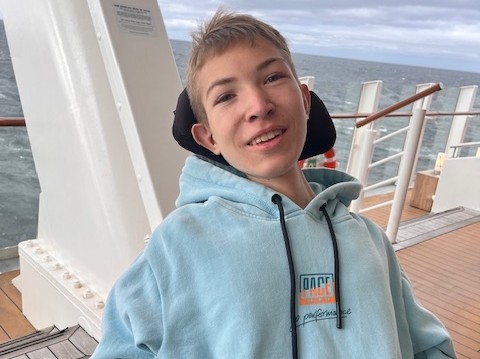
Dear readers, the interview with Silke Müller, „We need an education revolution,“ received a lot of positive feedback from you. Stefanie, 45, also got in touch. She said that what Silke Müller had said spoke from the heart of her daughter Emma, who is almost 14. Emma is on the verge of refusing to go to school. Of course, we wanted to know more, and both mother and daughter were willing to talk to us about it.
Emma, you are almost 14 and you are bothered by a lot of things that happen at school. What bothers you the most?
Emma: I think school starts too early in the day; in the morning, we’re all still much too tired at our age. Besides, the school day is too long. We’re out of the house for as many hours as adults are in a working week. After that, we’re supposed to do homework, work on projects or study.
Adults don’t have to do that; it would be considered a toxic working environment. But for us children, it’s supposed to be completely normal. I also find lessons really boring; most of the time, they have nothing to do with our real lives. School doesn’t prepare me for real life. When I explore topics online on my own (without AI), I learn more and faster than I do at school.
What would your dream school look like?
Emma: I would like younger teachers who are closer to our age and therefore understand us better. I don’t want to be stuck in a classroom all day. I need freedom, including freedom of movement, to structure my learning in a way that suits me. To this end, it would be helpful to have different, nicer and more comfortable rooms, quiet areas (it’s often too noisy in class) and generally fewer pupils per class. For me, more variety in the timetable/lessons would be good, the days would have to be shorter and start later so that I can go to school well rested.
I would also find projects and practical learning helpful. This includes being prepared for adult life (being able to sign contracts and such) and also gaining more insight into real work situations by participating in real working life in companies, not just an internship in Year 9. I would also prefer to be able to decide for myself when to take a break, because I know best when I need one.
The daily routine at school is simply too rigid for me. There are also too few contact persons and mentors for pupils at school, such as coaches, social workers and psychologists. Perhaps also people who could be reached outside school hours.
Stefanie, you say your daughter is on the verge of refusing to go to school because everything seems so far removed from real life. To what extent can you understand that?
Stefanie: I can understand that very well, especially because Emma’s ADHD also plays a role in her school life. School is detached from real life because it has little or nothing to do with the real issues facing teenagers today, or because it does not adequately prepare them for life after school. Furthermore, Emma is expected to function within a standardised system that has no place or capacity for children who do not conform to a specific norm.
Just the other day, she said, „I’d rather go to work and earn money,“ which says a lot about how much meaning she currently finds in school. You can largely choose your own workplace and help shape it yourself, and you get paid for your work – things she experiences neither directly nor figuratively in school life.
What worries you most about your daughter’s school career?
I just really hope that we can get through this. School isn’t always fun, and learning isn’t always easy. But when this area, which takes up so much of our daily lives and time, is nothing but torture or is fraught with so much frustration, it naturally saps all motivation. Persevering (through compulsory schooling) is currently taking a lot of energy from Emma, and it takes a lot of energy and tact from us as parents to support her in this situation, to talk to teachers and other professionals, and to find solutions or transitional arrangements.
The bottom line for us is not top marks or a perfect A-level. Emma should be able to graduate from school with a qualification that paves the way for her to go where she wants to go. But we want her to have a fulfilling and rewarding learning journey (one that challenges and stimulates her) and not one that is just rocky and bumpy.
How do you remember your own school days and what has changed (and what hasn’t) compared to today?
I remember my own school days as being fairly uneventful, with the normal challenges that adolescents face. Of course, even back then, we were less concerned with schoolwork than with our own life issues. The percentage of teachers or lessons that I remember fondly is small.
However, I do come from a time when having to function and everyone doing everything the same and equally was the standard programme. And unfortunately, these templates are still applied far too broadly to individuals today. Of course, it takes effort to look at what individuals need in order to thrive in an „educational system“. But that is precisely what it must be about.
Schools educate people who are supposed to be capable of living independently and being part of society. But we are all different, so in addition to training and knowledge, we also need to look at personality and provide good support in this area. Things are changing and have already developed in a promising direction. Unfortunately, however, these are still isolated cases when you look at how schools and teachers work.
Emma, are there also teachers who are different? Who push you, believe in you, support you in practical life skills and get you fit?
Emma: Yes, a lot really depends on the teacher. Unfortunately, there are too few teachers like that overall, and even then, there are only a few moments that feel that way. Teachers never feel like real points of contact to me. They often talk about respect and how they are our teachers. At the same time, we are supposed to talk to them when we have problems, but the distance is just too great.
How do your friends feel about all this?
Emma: Most of my friends feel the same way, but they’re mostly just annoyed or bored by school, yet they still manage to get by reasonably well. For me, the situation is drastically different because I also have ADHD, which makes school difficult for me in a different way.
What message would you both like to convey to politicians and everyone involved in education?
Those responsible really need to address the realities of life and the challenges faced by young people. Here, too, there is far too great a distance between those who make the decisions and those who are affected by education policy in real life. Those responsible and those affected must be able to engage in direct dialogue with each other.
Our world is changing so rapidly, and if we want to prepare future generations to cope with this, we need to listen to them and ask them what they need in order to not only survive, but also to live fulfilling and joyful lives. This also applies specifically to the topic of school.