A Filmmaker Shows Kids How Easily Fake News Gets Made
In one school workshop, rats took over the playground, then the classroom. Here's what happened when kids saw their own faces say things they never said.
Hi, friends! Lutz Winde is a filmmaker and a dad of three, and he now also gives talks at elementary schools on media literacy, fake news, disinformation, and how to check your sources. His workshop is meant, above all, to educate.
I've known Lutz personally for over 20 years (yes, we're that old!). I once walked up to him at a party in Berlin because I was sure we knew each other. Turned out he'd played Marco Busch on Marienhof, a German daily soap opera (Yes! I watched it back then, right alongside another soap, Verbotene Liebe). It was very embarrassing (for me).
We've stayed in touch off and on since then. Funnily enough, he later had a girl first and then twin boys, just like me. His oldest is now 12, which is phone age, and that got him asking: Why on earth isn't media literacy taught systematically in German schools?

Dear Lutz, what surprised you most after your daughter got a phone?
Mainly two things: 1. I was surprised by how fast she figured out all the apps, how quickly she connected with people, and how much she and her classmates came up with together, some of it very creative, like dance videos and that kind of thing.
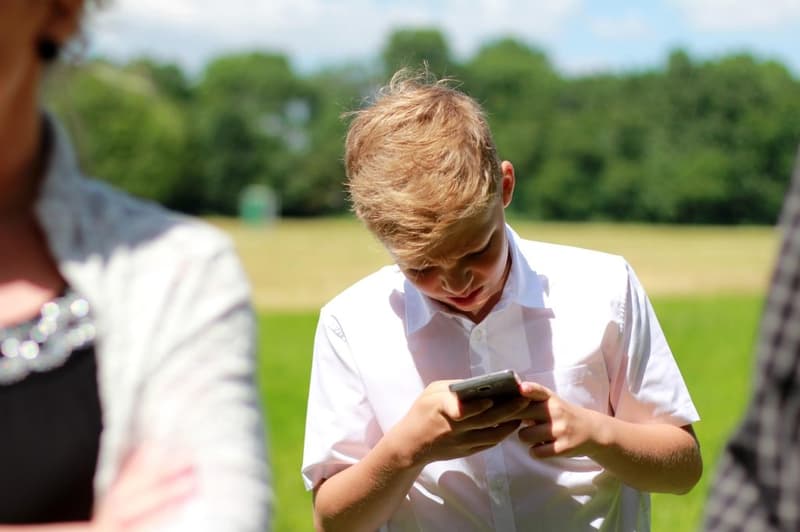
But there were also moments when she stared at her phone like she was hypnotized, swiping on and on. Where did you have to do some catching up yourself?
I had to wrap my head around the content, and why my daughter is shown one thing and not another. When I switch off and look out the window, for example, I may not see much, and it doesn't necessarily enrich my mind, but it's random and it's not staged. What I see there is true, real, authentic.
Everything, and I mean everything, I see on any platform on the internet is steered. Somebody wants attention because they want to sell something or push their opinion, or whatever it may be. And to get that attention, people manipulate and lie. Kids and teenagers have a hard time recognizing that.
When our kids first got phones, we told them: Never send anything you wouldn't be okay with seeing on a giant billboard in the next big city. And: Only accept friend requests from people whose hand you've actually shaken (so yes, decline Manuel Neuer too, the German national team goalkeeper! Who knows who's hiding behind that name…). What other rules should we follow?
When it comes to sending things, I absolutely agree with you. We have to make kids aware of what the WWW stands for. Namely WORLDWIDEweb! But even more important is what they accept, whether that's messages or friend requests, because by now those are often manipulated and untrue too, thanks to algorithms and AI. You really do have to explain this clearly, again and again, even if it annoys the kids. That's how my workshop came about.
How did you set up your media literacy workshop?
All this endless explaining and “theoretical know-it-all-ing” got on my own kids' nerves. So I wondered how I could introduce kids to the topic, and make them aware of it, in a creative way that's actually fun. I've developed and run lots of other film workshops, and kids and teens always think anything to do with FILM is cool, so it made sense to try something creative and hands-on with them (If you're interested: [email protected]).
The workshop is meant to show kids and teens how to write, shoot, and edit a news report the way a newsroom would. That means we work with images and text that are supposed to convey the truth, but even at this stage it becomes clear that people have different opinions.
In the second step, I show the participants how easy it is to say something completely different using the same footage, cut differently, and slightly different text (fake news). And in the third step, I show what you can do with AI, which is far more manipulative (deepfake news).
We can put something completely different into the mouth of the person we filmed reading the news, and in their own voice. Combine that with fake images and the result is even more shocking.
Afterward, we go back over it together and look at what to watch for to tell what's fake and what isn't. Where does manipulation begin, and how does an algorithm get us to see only what others want us to see, and not what we want? The workshop can run as a project week at schools, spread out over half a school year, or as a weekend crash course at youth centers.
What kind of feedback do you get from the students? Do they come up with wild stories?
A kid's imagination has no limits, of course. We shot a news report about a few rats on the school playground that were being fought with poison. In the fake news version, there were hundreds of them, and the kids had to escape onto the jungle gym so they wouldn't get eaten. In the deepfake news version, the rats finally took over the school and started teaching the students.
It was a lot of fun to shoot, of course, but it also made the kids more aware, and it shocked them when they saw words coming out of their own mouths that they never said, or themselves doing things they would never do.
So how can my child spot fake news?
Unfortunately, that's getting harder and harder. When in doubt, question where something comes from, which isn't always easy. If news shows up in my feed because I'd been reading about a topic, I always question it and look for other reports on the same subject. If lots of reports that don't depend on each other say the same thing, I can relax, especially if the publisher is a well-known news service and not a Chinese, Russian, or private outlet.
Of course, you can sometimes still spot fake news by the sound quality, and the images are often blurry in places or show digital glitches. But fakes keep getting better, and even I have a hard time spotting them right away.
Should I really try out all of my kids' games and all the social media platforms myself?
In general it's good to be able to join the conversation and to make it clear to kids that killing human-like beings shouldn't necessarily be the goal of a good game. But then again, as kids we shot down badly animated spaceships too. When it comes to age ratings, I'd rather trust trained psychologists and the USK, Germany's age-rating board for video games.
Does it make sense to tell your kid once a week: Hey, I respect your privacy, but on Friday afternoons we always take a look together to get a conversation going? (It led to great conversations in our house)
Tricky topic! Would we give our kids access to our WhatsApp? But in general, it's great when you manage to talk about these things with your kids at eye level. I'd bring it up case by case, though. There are often situations worth discussing, in school group chats for example, and the kids ask on their own how they should handle them. Or you get an email from other parents saying that people weren't treating each other properly in the class chat. Then you can have a good talk. Or you show your kids when you've just gotten spam in your inbox yourself, or a nasty comment on Facebook.
What else would you like to tell parents who are about to hand their child a first phone or tablet?
Hang in there, and err on the side of being a little too strict! It's no coincidence that governments are regulating social media more and more tightly. As long as the platforms don't get a better handle on their content, it will keep getting harder to protect our kids, because soon even we won't be able to tell fake from real.
Games, on the other hand, can be fun and even educational, you just have to look for good ones. There are great apps, too, and you can also make phone calls on these devices, after all. So it's not the devices themselves, although I'd say looking out the window has something going for it sometimes, too…
This story first appeared in German on StadtLandMama.