Suicidal mum: „Lukas died, he didn’t do this to me“
Dear ones, at the beginning of the year, I became aware of Sonja, who posted on the Jugendnotmail Instagram channel as a mum bereaved by suicide about her life after the loss. Her son Lukas died three years ago at the age of 17, and since then his mum has been making sure that education can take place – and is bravely venturing back into her life.
We met in person in Cologne at the end of May and hit it off straight away. Sonja has the last sentence of Lukas‘ farewell letter tattooed on her left arm – in his handwriting, as he was left-handed. Next to it sits a raven, his favourite bird. Lukas was socially integrated, he had hobbies, a circle of friends and was involved as a course and class representative until his life changed radically due to alleged bullying.
In the following interview, Sonja tells us their story. Please think carefully about when and in what setting you read the story and whether there might be someone with you if your emotions get the better of you.
As the following is about suicide, we would like to give you these important tips at this point: If you find yourself or your children in an acute crisis, please contact your treating doctor or psychotherapist, the nearest psychiatric clinic or the emergency services on 112. You can reach Telephone counselling around the clock and free of charge on 0800-111 0 111 or 0800-111 0 222.Young people in need can get free advice by email from Jugendnotmail. Nummer gegen Kummer also offers free and anonymous counselling for children, young people (116 111) and adults (0800 111 0550).
Factual classification: According to the Federal Statistical Office, more than 9,000 people commit suicide in Germany every year; in 2023, the figure was 10,304. Suicide was the most common cause of death among 10 to under 25-year-olds in 2023, ahead of road accidents and cancer. 18% of all deaths in this age group were suicides. According to the World Health Organisation, there are up to 20 attempted suicides for every completed suicide. The families of these people are also affected. So we are not dealing with a marginal phenomenon here, but with hundreds of thousands of people every year who come into direct or indirect contact with the topic.
Dear Sonja, you are a mum bereaved by suicide. How do people react when you tell them that your son Lukas died by suicide?
At first, it usually feels as if there is suddenly a strange silence between the other people and me. As if separated by a veil. A few people push the veil aside and either give me a hug or say they’re sorry or „Oh dear“, „Oh my God“, „I don’t know what to say“ – that’s my favourite option because it’s so honest!
No one can and especially MAG imagine finding their own child and having to bury them. No one even likes to imagine losing their child. I was always afraid of it – strangely enough, looking back. Somehow, and this may sound spooky, I realised that my special child was a temporary gift. However, I had no idea that it would only be 17 years.
Some phrases also hurt you a lot…
Yes, because they convey the feeling that the other person doesn’t want to deal with me and my loss. And, even worse, they play down my feelings. I have also set myself the task for my life 2.0 of explaining how to deal with those affected and breaking down inhibitions.
Phrases after Lukas‘ suicide that really hurt me and almost silenced me were, for example, sentences like „Oh Sonja, he wanted it and there was nothing you could have done anyway“ I’m his mum, I can’t deal with the fact that I couldn’t save him shortly after the death of my child. Some days I still can’t! I couldn’t help him and I was too late to save him; he was dead when I got home… These thoughts were very present after this phrase, for example, and my accusations against myself became even louder.
Or sentences like „He’s better now!“ What does that mean? Was he doing badly with me? I now know what that probably means… But to hear something like that shortly after the death of the child felt very hurtful. But I found the worst sentence „That he could do that to you, I feel so sorry for you!“ Luke didn’t do anything to me, he died… I love him and I have never and will never think that he did anything to me. That sentence makes my son out to be guilty and he’s not, not at all.
I also find the enquiry – fortunately from only a few people – about how Lukas committed suicide very bad and offensive… Women in particular also have this mixture in their eyes between pity and huge fear that hopefully it won’t happen to them.
Can you be more specific about what exactly bothers you about the question of how, i.e. the chosen form of suicide?
I’m not fundamentally bothered by it. But what I do find, yes… intrusive, is when I haven’t spoken to someone much about Lukas yet or I’m contacted on Instagram and the question comes up in the initial contact. Lukas died by suicide, suicide is the cause of death, the worst and last symptom of his illness, depression. If Lukas had died in a car accident, would the question of how… come up immediately? If people understand that, they might become more sensitive in their dealings. It’s so ‚intimate‘. Although: somehow that’s not the right word.
I’ll try it another way: Lukas made up his mind in an absolutely exceptional situation, he left nothing to chance. My son is so much more than the way he died and that hurts me. He committed suicide and I was the first to see him. I even compare it to giving birth. My son and I, he so innocent and pure. And I kind of want to decide for myself when and if at all and to whom I tell how. Because the method I choose makes no difference to the situation I find myself in…
Who was Luke?
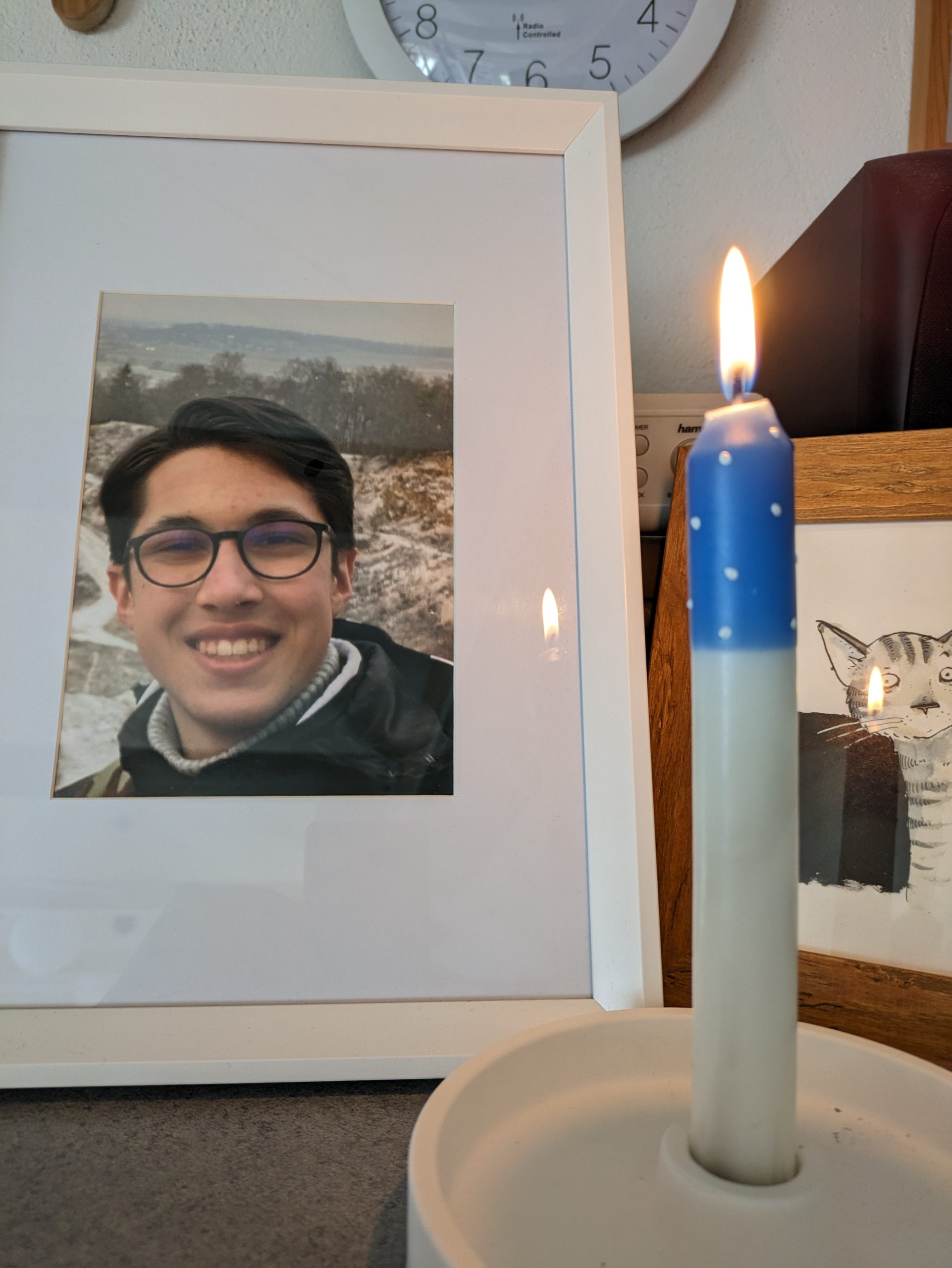
Lukas was wonderful, beautiful, someone on Instagram once wrote to me: „You can see he’s beautiful on the outside as well as the inside“. It’s like this: You can only see well with your heart, the essentials are invisible to the eyes. Luke was brought up like this, and not at all superficially.
As a baby, Lukas was the best you could wish for. He was an absolute dream child and was brought up with love. His great empathy was already evident in kindergarten, he liked to help, was good at memorising and was very inquisitive. He didn’t like large crowds of children and disliked the crowded kindergarten; he enjoyed the holidays when there were very few children there.
I didn’t know anything about high sensitivity back then, unfortunately; I often heard even from nursery teachers that he was very, very difficult and sensitive. What rubbish, I thought to myself every time. He’s just a boy who wasn’t happy when he was kept busy with a football. I was glad when nursery time was over… and so was Lukas. He was really looking forward to learning at school. He already spoke very well as a child, quickly memorised children’s books and our bedtime story ritual was sacred to us both.
How did he organise his free time?
He didn’t value extended play afternoons with lots of children at home, he always preferred girls to boys and so he usually spent hours playing with the neighbour’s girl, something I had to justify and defend to some mothers. It was always clear to me that I respected and supported Lukas‘ wishes. As I was always working, my free time was Lukas‘ time, we made it nice…
I am a person who has always been aware of moments, I may sometimes feel too much, but it is what it is. Lukas was very ambitious, in third grade he said: „Mum, I want a recommendation for grammar school.“ I wasn’t so sure about grammar school… Maybe it was my gut feeling?
Lukas made it (of course ;-)). He got the recommendation and then went to grammar school – together with his suspected future bullies. He struggled at first, but from Year 7 onwards he was one of the best in his class, was involved as class representative and represented his school in „Jugend debattiert“ until 2022. In his spare time, he was an enthusiastic judoka from the age of 6, later becoming an assistant coach and a favourite with youngsters, coaches and teachers alike.
What about his circle of friends?
He never had to fight for friendships, they just came to him, he always chose carefully as he detested superficiality and quality was more important to him than quantity. At 16, Lukas made the decision that he didn’t want to accompany his best friend at the time to drinking parties. Paradoxically, we as parents still tried to persuade Lukas to go because I realised that he could be excluded with this attitude.
Lukas was also very clear about his position and went through with it. He now had another small circle of friends, consisting of two boys and a few girls. Lukas was 16 – almost 17 – a teenager, we trusted him and he trusted us. He enjoyed being able to talk to the two boys about God and the world (in the truest sense of the word ;-)) and not just chatting about girls, drugs and music after an hour.
Lukas wanted to study philosophy and theology, read Seneca and had a poster of Albert Einstein in his room. He was preoccupied with death, life, faith… He went to Carnival 2022 as a cardinal, how bizarre looking back.
What did the former circle of friends think?
The former best friend couldn’t understand or cope with this „rejection“ from Lukas and started to ostracise him. At first, he bombarded Lukas with messages about what a bad friend he was. Lukas was surprised at such childish behaviour and thought he had explained it.
At this point, he could still smile about these actions… but then things got more serious: the former friend removed him from all the WhatsApp groups they were both in and blocked him in all chats. He quickly gathered a group around him that Lukas liked, but who didn’t want to be out of the other person’s good graces. That’s how the bullying system works.
Lukas was faced with a large group that was presumably against him. For the first few weeks, he was able to handle it for himself, he talked to us a lot and found the behaviour of the others uncharacteristic and shabby. But he said to me: „You know, Mum, I now know what kind of people they are, childish, stupid and superficial…“
How did the situation change then?
After a few more weeks, he withdrew more often; it was a difficult balancing act between „Is this puberty?“ and „Is Lukas ill?“ He never completely shut himself off from me, we started going for walks or travelling by car a lot; these were always the times when Lukas talked a lot. He always played down the behaviour of others, especially that of his former best friend. But I sensed and knew that boundaries were being crossed. I think Lukas was so disappointed that he didn’t want to admit it.
At the end of November, he came to me and said he would like to talk to another adult besides me, our family doctor. He had previously been in contact with the „Nummer gegen Kummer“, which was good because it wasn’t „face to face“ for the time being. I think this also gave him the confidence that he could be understood by adults.
From then on, everything happened quite quickly – fortunately: a moderate depressive episode was quickly diagnosed; Lukas was still at school at the time. The first consultation at the child and adolescent psychiatric centre was in February 2022. Lukas was „happy“ to have a diagnosis; it was so important to him not to be considered lazy, not to be suspected of malingering. And it was also very important for Lukas to be able to talk openly about his diagnosis at school.
What happened from then on?
What his teachers thought of him was particularly important to Lukas and so he was happy that I arranged a meeting with the head teacher and his tutor to talk about Lukas‘ health. I was of course sad that my cheerful, empathetic, intelligent, beautiful child was mentally ill; it only happened to others. But no, now I learnt that it can happen to anyone.
I tried to support Lukas so that he could still manage his life plan, even if it took a year or two longer. For me, the Abitur was something of a second or third priority, but not for my son; thinking about repeating a course level was a shock for him.
Did Lukas talk about suicidal thoughts?
We talked about suicide. Not about his own, but about other people’s. Lukas always showed understanding for the suicidal person, I didn’t find that strange or worrying. He simply thought that we should understand the person who chose to take this difficult step and not blame them for something they could no longer bear… typical budding philosopher.
On the psychiatry questionnaire there is a question:Have you ever had suicidal thoughts? Lukas thought this question was stupid, because „Nobody can tell me that there is someone who has never thought about what it would be like to stop living“ „Sure – I’ve thought about it before“ was his answer!
What happened next with psychiatry?
From mid-February 2022, Lukas received weekly care and sometimes spent two days in the psychiatric outpatient clinic. The therapist confirmed the diagnosis of depression and suggested that Lukas be excused from school for the time being, as this was the most stressful place for him. Lukas didn’t want that at first; school, his A-levels, his whole future… it was all so important to him.
The psychiatrist clearly stated that there should be no further bullying attacks or other injuries. Lukas was getting worse, he ate little, was sad and often needed a lot of closeness. I was at home a lot and was able to work from home. From then on, it was even more important to me that Lukas wasn’t alone.
Another injury was added after all…
Then the terrible thing happened: a meme on Instagram, posted on 7 March 2022, in which Lukas was asked by teachers to make a video introducing the school, together with a classmate. This video received high praise, which was apparently too much for the envious people.
A meme was published at the beginning of March 2022 that showed a comedian stepping in a dog poo. It read: „Ew, I stepped in shit…“ And under this „Shit“ was the link to the school homepage and the video of Lukas and the classmate. The account still exists today. That was the last straw for Lukas: nervous breakdown, powerlessness, helplessness, feeling lonely, self-worth broken….
The school management was informed immediately and there was also a general lecture at school on how to deal with each other on social media. There were no consequences for the course level. Lukas went to school for a few more days, he had faith and hope that it would all stop because the injustice would be seen. But that didn’t happen; Lukas experienced silence and perpetrator protection. He could no longer go to school, he was too weak. It all happened between September 2021 and May 2022.
Can you take us back to May, at least in part?
Lukas died on 11 May 2022, a sunny, warm Wednesday, I was in the office in the morning and we texted each other just before 10 a.m. to see if we wanted to go out for ice cream at lunchtime. He wrote that he didn’t really want to and I understood him. Going out in the heat with depression, with mum and then knowing that others were having fun together at the lake…
I understood him and carried on working. The memories of that day are all still with me, and I often still have the smell of Lukas in my nose. I called it a day at 12.30, drove home and found my son. I dialled the emergency number and it felt like everyone was there immediately: police, emergency doctor, police… I made all the important calls with the help of the emergency counsellor, who was right there (I think together with the police), and also informed the school. The deputy headteacher had to cut the call short as he couldn’t talk any more; everyone was stunned.
At this point, I was „in the film“, I couldn’t cry, I stroked and kissed my son; when the funeral director arrived, the text for the obituary gushed out of me, I felt I didn’t have to think at all. I also quoted Lukas‘ words, which are now on my left arm, in the obituary.
What happened next?
A few days after Lukas‘ death, I sought dialogue with the school in the belief that they were committed to punishing the alleged bullies or making them feel the consequences and also that bullying and suicide prevention would be implemented. However, it seemed to me that the priority was to keep the school quiet.
I didn’t seek out a conversation with the alleged bullies (there was no judgement, so we have to talk about „alleged bullies“), I saw them at the memorial service for Lukas at school and they were so self-assured in their behaviour that I didn’t have the strength. Two of them live very close by. There was not a word of apology, insight or even awareness from either the parents or the young adults.
When the class of 2023 celebrated their graduation, it was terrible for me; Lukas would have been there too, we didn’t get an invitation to the graduation ball (regardless of the fact that we wouldn’t have gone), but we were simply excluded. There wasn’t even a flower or a wreath on Lukas‘ grave… he simply no longer existed. That’s how it feels. And I’m pretty sure that if Lukas had died in an accident or through illness, his death and his memory would have been dealt with differently.
How has your everyday life changed, how do you currently fill your days?
My everyday life has changed completely, from one second to the next. I can no longer do my job at the moment. About seven months after Lukas‘ died, I was back at work and happy to have great colleagues. I felt a little bit ’normal again‘, in a normal everyday life, but for me it was the wrong path, I collapsed exhausted after about 17 months.
I didn’t suppress Lukas and continued to go to therapy, but I still felt how hard I had to and wanted to make an effort during working hours. Today I know it was about control, I wanted control, at least over myself. I wanted to be a normal wife and mum who worked. Nobody demanded it of me, except myself. But at some point I couldn’t sleep any more, I was totally exhausted and I couldn’t go to the office any more, socialising was too much. I’ve been unable to work ever since.
In my subsequent rehab, I learnt to accept that I couldn’t work at the moment. That was (and still is on some days) a huge hurdle for me. Maybe that’s the control issue again…
Where are there still restrictions?
For a long time, I couldn’t even go for a walk, let alone do any sport. Rehab gave me the go-ahead again and the positive effect of exercise is undisputed. I’m now regularly out and about again, doing yoga and Pilates.
After Lukas‘ death, I simply didn’t really know what my needs were, what was good for me, what helped me, what I should and shouldn’t allow myself to do. How could I?
I no longer even knew who I was or what I was supposed to be doing here in this life.
I can always be about myself, that is one of the most important things I have learnt in recent years and months.
My days are now filled differently with things that help me and do me good. At the same time, I also need a lot of rest as I get overstimulated quickly, but I enjoy company when I can, new people, old friends, art, talking about all sorts of things and talking about Lukas is always nice anyway.
The amount of energy I need for some things has increased. I can’t even manage some things at the moment; I’ve already learnt a lot and am still learning to accept it and I want to encourage people that we can manage it.
Does the grief come in waves or is it more of a heavy blanket?
For me, it’s waves, sometimes very gentle… sometimes it knocks me over, I’d say. Like the last time in May. The anniversary of Luke‘’s death fell on Mother’s Day this year, the following week was my name day and two days later was the First Communion of my goddaughter, Luke‘’s cousin. He loved her very much!
After that, I was knocked out. I couldn’t do much physically apart from breathe. In the meantime, I know how to deal with it better, I don’t fight it (it doesn’t make sense anyway), I feel, cry, read (if that’s possible) or write on Instagram. My account and the connection help me a lot…
I can allow trust again, I couldn’t for a long time. I lost control completely, which I think is one of the most difficult life situations a person can cope with (hopefully); I’m still learning. The grief of those bereaved by suicide is different, you can’t come to us and let go of empty phrases. There are questions such as guilt, why and the constant attempt to understand the sudden death in the first place.
Does your grief change over time?
Yes, the path of grief is in a constant state of flux. As I said, I was in a five-week rehab programme in Bad Kissingen at the beginning of 2025, which did me a lot of good. I met people there who were suffering from mental illnesses, some of them as a result of loss, others due to professional situations. Or young people who had experienced bullying. The value of this exchange, even outside of therapy times, was enormously important for me.
What was most important for me there, apart from my psychologist, were my „rehab people“, my group. We were all united by deep honesty, honest empathy, they were and are simply amazing people and the dialogue was so valuable. We are still in contact and I hope that a meeting will work out in the near future.
This experience was hugely important for me, as I had lost so much self-confidence due to the behaviour of school officials, parent representatives and other parents. In addition, I was still aware of the stigmatisation, as I was the one whose son had committed suicide…
People have thought about this?
Many people quickly realised what was wrong with us at home, that Luke had died this way. Some of the way I was treated was really awful. Disrespectful and totally unexpected for me. Nobody should have to experience that. From the rehab period onwards, things were different: I learnt that people liked me, people valued my opinion again. We talked about Lukas as a matter of course.
My Instagram account also helps me and something has changed since rehab: I grieve publicly, so to speak, and I think that’s absolutely necessary. We need to talk openly about grief after suicide; it’s a way of dying – no more and no less – I show myself openly, vulnerable, but also strong and simply approachable. I am a completely normal woman who also always thought that something like this only happened to others. Only if we talk about death, grief, mental illness and bullying can we reduce repetition. Lukas is not an isolated case – it happens, but we can prevent it.
You have changed
.
Yes, totally, I was immediately a different Sonja after Lukas‘ death; now it’s slowly starting that I can find this development, this growth good.
I think Lukas sometimes directs strange things that I don’t understand at first, but I believe or hope that I still have something to do here in this life… and that should be in Lukas’s sense.
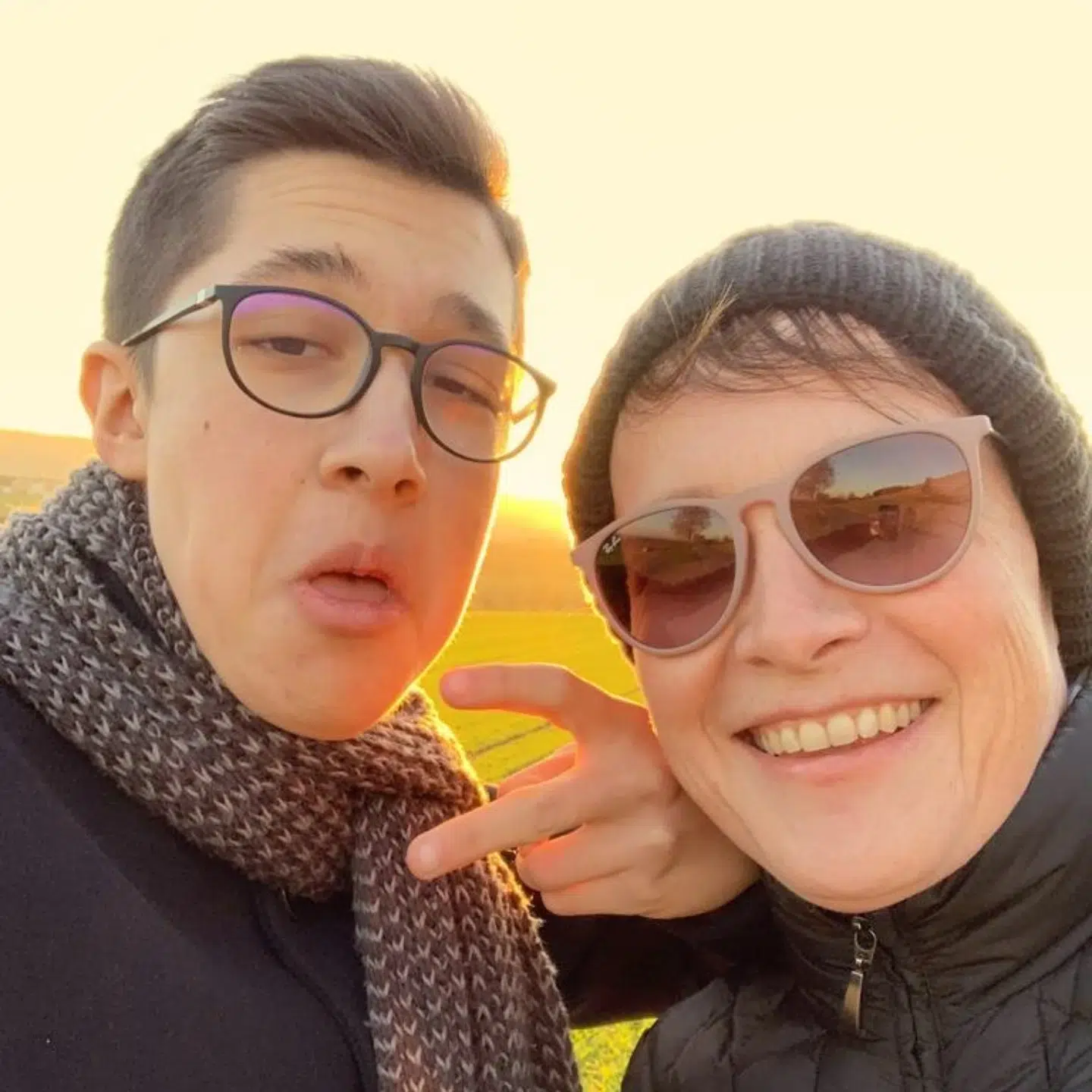
Sonja at our meeting in Cologne
You are now also raising your voice publicly, you have amessage…
By being public on Instagram, I get a lot of encouragement and that does me a lot of good; it also shows me how many children, young people and families are suffering – bullying is a problem that must not be hushed up.
I feel right about what I’m doing and I’m sure it’s in Lukas‘ interests. He felt alone so often, there was no one at school he could talk to.
Lukas didn’t have a suitable contact person at school; he couldn’t and didn’t want to open up there. I had no opportunity in my immediate environment to draw attention to bullying, responsibility and suicide prevention; the school also reacted negatively to suggestions to this effect. There is still a mentality here that there is no such thing; everyone has everything under control and children who talk about offences and feelings are „just too sensitive“. That’s why I’m taking this approach, in the hope and with the intention of shaking things up.
My account is not an account of blind accusation, I like to draw attention to dangers and every person I can make think is valuable to me. I want to draw attention to the consequences of bullying, to show children and young people that they can always speak up and that we adults have to listen and be loud; that’s my goal.
My account is intended to be a source of support for survivors of suicide, as well as raising awareness about bullying and its effects and reducing the inhibitions that others often have when dealing with survivors of suicide. And if I can then perhaps manage to reduce the inhibitions that others often have when dealing with survivors of suicide. Then that would be a great treasure, I believe that if we affected people take away the worries of others, the world will be a little better. I’m just a normal woman, mum, Lukas‘ mum – that’s it!
You think bullying is played down too often…
No child is born a bully; parents, teachers, aunts, uncles, we all have to look out and teach values. This starts with the youngest children; it’s not funny when the „little bully“ boxes his way through nursery and the „sensitive little one“ is afraid of every day at nursery. Teachers and trainers have a role model function, not just a teaching function. Bullying is unfortunately too often played down and that can cost lives. I know that teachers are often under so much pressure themselves that they know what would be morally right, but can’t put it into practice for fear of reprisals.
School reforms should definitely change that. Our children are great! We are the ones who make them what they are. It’s not just our children and young people who have a responsibility, their parents do too. Everyone must be aware of this. We lay the foundations, we give them values.
There is no such thing as THE bully, just as there is no such thing as THE typical victim of bullying. Lukas was tall, slim, athletic, intelligent, had a strong character, was polite and good-looking. I would never have thought that a small group of teenagers would manage to break my wonderful son’s self-confidence within a few weeks. Nor that my son, who grew up full of love, would become mentally ill. Nor that my son would die by suicide. But that’s exactly what happened. And I’m doing everything I can to prevent this from happening to so many more people.
Lisa Harmann
Lisa Harmann has always been curious about everything. She works as a journalist, author, and blogger, is a mother of three, and lives in the Bergisch region near Cologne, Germany.